
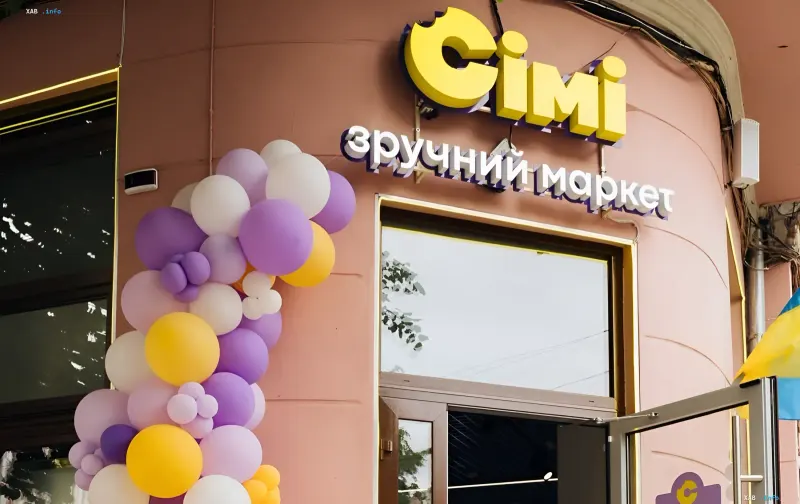
Ukrainian retail is undergoing a fundamental transformation. Amidst military hostilities, priorities have shifted from giant hypermarkets to compact formats and energy autonomy. The concept of the 'store near home' has proven its viability: it requires lower capital investment and ensures operational delivery, making this segment the fastest-growing in the market.
The leaders of this trend are regional convenience format players. A striking example is the 'Simi' chain (operator LLC 'Clover Stores', owners Dmytro Merchenko and Serhiy Kikinev). In 2025, the company demonstrated explosive growth, opening a record 133 new outlets — an increase of 41%.
As of June 2026, the company's portfolio, including the classic 'Sim23' format, counts more than 500 stores. The geography of presence covers seven regions of Western Ukraine: Volyn, Lviv, Ternopil, Ivano-Frankivsk, Rivne, Khmelnytskyi, and Chernivtsi.
Finance and Risks: The Price of Aggressive Growth
The expansion of 'Simi' is underpinned by serious financial indicators. According to Opendatabot and Clarity Project data, 'Clover Stores' revenue grew by 54% and reached 7.94 billion hryvnias. However, the aggressive development strategy requires colossal investments: the company's net profit amounted to about 38.8 million hryvnias. A profitability level of 0.5% is a typical indicator for dynamically growing convenience retail.
One should not forget about the risks faced by businesses in frontline and western regions. The chain's own distribution center in Lutsk has repeatedly become a target of attacks from the Russian Federation, including strikes in 2026.
'Blyzhenko' and the Revenue Growth Phenomenon
Another key player in the West is the 'Blyzhenko' chain, part of Berta Group under the management of Lviv businessman Oleksandr Berezhanskyi. The retailer controls the Lviv region and five neighboring ones: Ivano-Frankivsk, Ternopil, Zakarpattia, Chernivtsi, and Volyn.
As of June 2026, the chain counts 302 stores. The company's financial figures are impressive: the revenue of LLC 'Servis Lviv' for 2025 reached 8.4 billion hryvnias. This is a phenomenal growth of 396.4% compared to the previous year, which allowed the company to enter the rating of the largest food retailers in Ukraine.
'Arteil' Strategy and Competition in the Capital
Unlike the western leaders, the KOLO chain, managed by 'Arteil' company, is oriented towards other regions. Through BGV Group, it belongs to the business pool of Hennadiy Butkevych — co-owner of ATB. The chain is concentrated in Kyiv, Kyiv region, and Odesa.
As of 2026, KOLO counts from 251 to 259 stores. Revenue for 2025 grew by 23.3% and amounted to 3.28 billion hryvnias. Experts note that 'Simi' wins in terms of total revenue due to the huge number of outlets in the west, while KOLO competes effectively in the 'expensive' capital region. High average check and population density allow for better margins even with fewer stores. For ATB, the KOLO chain serves as a strategic addition in the 'store near home' format.
New Architecture of Shopping Centers
The trend towards compactness covers not only retail but also the construction of commercial real estate. According to the Ukrainian Council of Shopping Centers (URTC), from 2022 to 2027, 69 new shopping centers have appeared or are planned in the country, predominantly in the west. 80% of them are small-area objects.
The head of URTC, Maksym Havryushyn, explains this with the logic of military risks: smaller objects are less vulnerable and require less investment. 'Any shopping center can become a target for a drone or missile. It is better to build two small shopping centers than one medium one,' he notes.
Regional leaders 'Simi' and 'Blyzhenko' are currently holding their positions and are considered potential buyers in the mergers and acquisitions (M&A) market. However, their long-term future depends on how deeply national chains will enter the western Ukrainian market, emphasizes GDS Commercial Director Anna Anisimova.


