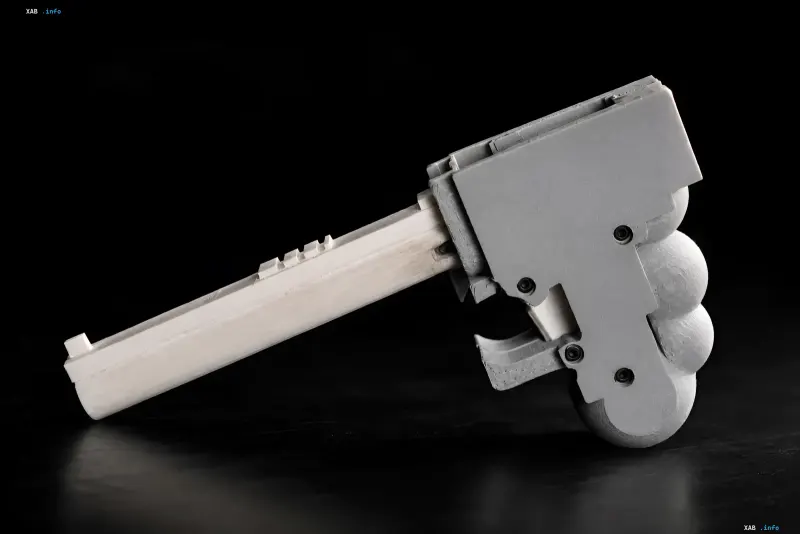
American activist Cody Wilson, known for promoting weapons manufactured using additive manufacturing methods, has unveiled the WASP pistol, which he claims is the first firearm ever designed using artificial intelligence. The new device was manufactured at the Defense Distributed headquarters in Austin, Texas. The device is a single-shot pistol chambered in .22 caliber: its frame is 3D-printed from standard plastic, while individual components are made of metal. In appearance, the WASP resembles Wilson's earlier Liberator model, and the printing process itself took about six hours.
Demonstration: Misfire on the First Shot
During a public demonstration, the pistol failed to fire on the first try — the initial shot resulted in a misfire. Only on a second attempt did the weapon discharge and puncture a cardboard target. Overall, during testing, the WASP functioned successfully in two out of three instances, which in itself became a subject of discussion: for a device claimed to be the product of AI work, such instability appears telling.
How the WASP Was Created: GatGPT Model and DEFCAD Library
To develop the pistol, creators used GatGPT, a proprietary AI model built on the extensive DEFCAD digital weapon file library. The DEFCAD project, launched back in 2012, provides public access to blueprints for firearms and their components. According to Wilson, a company employee asked the model to redesign an existing single-shot pistol configuration to achieve complete functionality and an original appearance. The AI proposed the WASP design, after which the team approved the plan and manufactured the parts. Currently, access to GatGPT is open to only a limited number of users. Wilson emphasizes that the WASP initially existed as a digital model and calls it an AI product, although the creation process itself began with a specific human prompt.
Expert Assessments: From "Awkwardness" to "Conditional Functionality"
Experts interviewed by The Verge were skeptical about the quality of the development. Firearms historian Ashley Hlebinsky drew attention to the unusual grip shape and unfinished trigger guard. Jonathan Ferguson of the UK's Royal Armouries museum described the pistol as only conditionally functional: in his assessment, the weapon is uncomfortable to hold and aim, and its design does not look technically well-thought-out. Thus, Wilson's claimed "first" in the realm of AI weapon design remains questionable from an engineering quality standpoint.
Context: The Return of the "Ghost Gun" Debate
The emergence of the WASP has renewed attention on the issue of so-called "ghost guns" — firearms manufactured without serial numbers and standard manufacturer oversight. Critics fear that AI-powered tools will make it easier for people without technical experience to create such items. A representative for Everytown, an organization advocating for stricter gun control, stated that such tools lower the barrier for self-manufacturing firearms and pose a threat to public safety. Wilson, in turn, believes that such systems will eventually allow new designs to be created faster: the more files in the database and the more actively users discuss solutions with the model, the more sophisticated the results will be, in his view.