On November 3, at least four passenger flights in Europe became the target of bomb threat reports — a day after a similar incident involving the redirection of a Wizz Air aircraft. According to TPO, the episodes spanned Poland, Bulgaria, and Spain, leading to route changes for several planes and the temporary closure of one of Warsaw's airports. As of publication, all checks have concluded without the discovery of explosive devices, though authorities emphasize that a connection between the incidents has not yet been established.
LOT Flight from London Redirected to Modlin
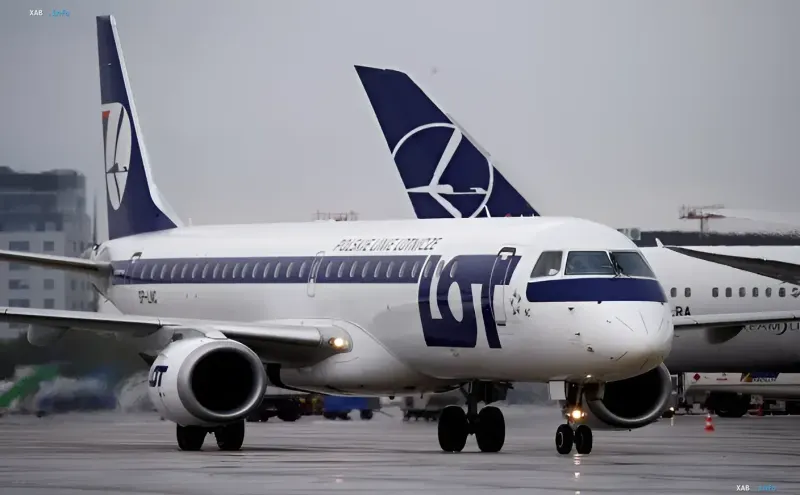
The most prominent incident involved a plane belonging to the Polish airline LOT, operating a flight from London to Chopin Airport in Warsaw. There were 181 passengers on board. Following a bomb threat report, the aircraft was redirected to the nearby Modlin Airport, which was temporarily closed while the plane was inspected. Upon completion of the check, no suspicious devices were found, and the airport resumed normal operations. The accompanying photograph shows the LOT aircraft on a wet runway — featuring its characteristic blue stripe along the fuselage and the carrier's logo on the nose section.
Inspections in Warsaw, Sofia, and Murcia
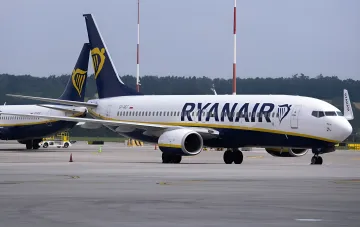
Simultaneously, an SAS flight from Copenhagen landed on schedule at Chopin Airport, having also received a threat report. Airport representatives stated that no suspicious devices were found and terminal operations continued as usual. In Sofia, a flight arriving from Israel was directed for inspection after receiving an email threat: Bulgarian Interior Ministry Secretary General Lyubomir Nikolov stated that counter-terrorism units were checking the aircraft for explosive devices. In Murcia, Spain, several airport areas were cordoned off following a threat report aboard a Ryanair flight from Manchester. According to Francisco Lucas, the Spanish government's representative in Murcia, all 114 passengers and 7 crew members disembarked and underwent security checks, while the aircraft itself underwent a thorough inspection. Officials later classified the report as a false threat: no explosives were found, and the airport returned to normal operations.
Background: Wizz Air Redirection on November 2
The November 3 episode followed on from the previous day's incident. On November 2, a Wizz Air flight from London to Sofia was redirected to Budapest Airport after receiving a bomb threat report, as announced on social media by Hungarian Defense Minister Kristóf Szalay-Bobrovniczky (reported as Romulusz Ruszin-Szendi in sources). The recurrence of such scenes across different countries within 48 hours indicates to observers that the threat reports may be serial in nature, although official confirmations of this version are currently lacking.
Context: Protests and Cyberattacks in Europe
The wave of aviation threats is unfolding against a backdrop of tense security conditions in several European countries. Large-scale protests in France, Germany, and Italy have periodically escalated into clashes with law enforcement, forcing authorities to deploy water cannons and tear gas. Simultaneously across the continent, from Sweden to Belgium, cyberattacks targeting supermarket refrigeration and freezing equipment have been recorded, forcing stores to dispose of spoiled food. The combination of these factors creates an atmosphere of heightened vigilance where even false threat reports can cause significant operational disruptions at airports.
Connection Between Incidents Not Established
At present, it remains unclear whether the four incidents on November 3 and the Wizz Air episode on November 2 are connected. Authorities in each of the affected countries — Poland, Bulgaria, and Spain — are conducting investigations independently, and the provided materials contain no single coordinating statement about an EU-level investigation. All recorded threats as of publication proved to be false, no explosive devices were found, and airports returned to normal operations following inspections.