
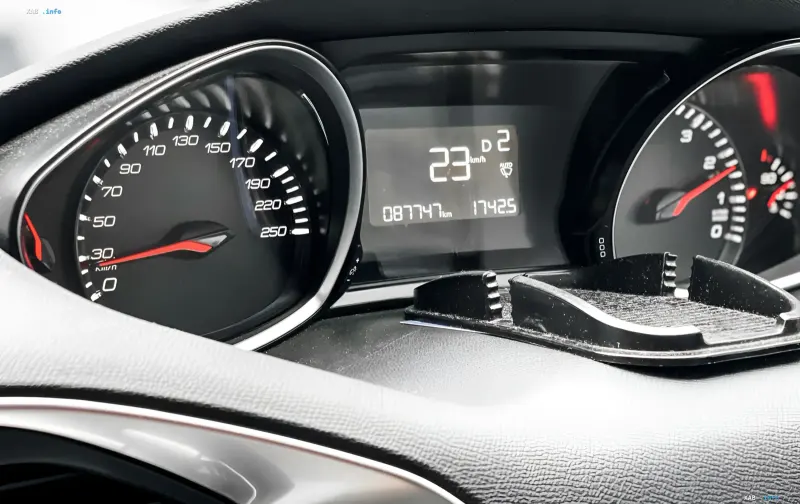
Experienced motorists who have changed dozens of cars in their lives claim things that are hard to believe: it is practically impossible to find a car with an honest mileage on the modern car market. If this is indeed the case, a logical question arises: how then to choose a used car and not run into 'wrecked' equipment?
The statistics of the Ukrainian secondary market demonstrate a surprising, at first glance, unanimity. The overwhelming majority of cars offered for sale have a mileage in the range from 180 to 220 thousand kilometers. For those who do not delve into the sociology of the car market, such a concentration of cars with the same mileage looks suspicious.
An even stranger fact is the comparison of prices. When comparing offers on Ukrainian and European platforms, it turns out that cars with such mileage in Europe cost significantly more. The paradox is that it is from Europe that these cars are imported to Ukraine for resale.
Why cars 'live' longer in Europe
The answer lies in the mentality of the owners. In developed European countries, pragmatic car owners rarely sell cars with low mileage, trying to fully 'recoup' the money invested in buying a new car. The first owner abroad usually manages to rack up from 300 to 400 thousand kilometers by the time of sale.
From here arises the main question: where does such an abundance of passenger cars with a 'golden' mileage of 200 thousand kilometers come from in Ukraine, and at attractive prices? The answer is simple and a bit scary: these indicators are 'made in Ukraine'. In reality, such cars are 'created' from more worn-out examples by correcting the data.
Mileage psychology and technical risks
When choosing a used car, the buyer relies on two main factors: age and mileage. Age is important for assessing the condition of the body and the degradation of the traction battery (for hybrids and electric cars). With this indicator, everything is transparent — it is extremely difficult to forge the date of manufacture.
Mileage, however, reflects the condition of units and aggregates: engine, transmission, suspension, and control systems. Manufacturers calculate the resource of these components for a certain mileage — from 200 to 500 thousand kilometers, depending on the class of the car. After passing this threshold, the mechanisms require expensive major repairs.
Every owner strives to sell the car before this moment arrives to avoid expenses. As a result, a so-called 'psychological threshold' has been formed in the market. In Ukraine, for cars 5–7 years old, it is at the level of 200 thousand kilometers. Sellers often cannot resist the temptation to adjust the odometer readings to this 'ideal' standard to sell the lot faster.
Is it legal to roll back the mileage?
It would seem that adjusting the odometer readings is obvious fraud. However, from a legal point of view, the situation is ambiguous. Lawyer Yevgeny Bulimenko notes that there is no direct violation of the law here.
"Strictly speaking, all technical characteristics and the condition of the car must be recorded in the contract. This is a question for the buyer on how he will verify the truthfulness of the mileage," explains the lawyer.
Theoretically, the transaction can be challenged by referring to Articles 229 and 230 of the Civil Code (transactions under the influence of fraud). However, in practice, this is extremely difficult: the buyer will have to provide the court with irrefutable evidence that the seller intentionally concealed the defects of the car.
How to hide the real mileage
From a technical point of view, rolling back the mileage is not a problem. Services for adjustment cost about 200–300 euros, or you can buy a specialized device, for example, Mileage Master, connected to the OBD port.
However, it is becoming more difficult to do this unnoticed by a professional appraiser. An important nuance is that in most modern models, mileage is recorded not only on the dashboard. Data is duplicated in several control units: in the memory module, engine hour meter, gearbox ECU, and climate control unit. It is the discrepancy of data in these memory cells that often reveals the falsification.


