Debates over the 30% gross revenue commission retained by Steam and other major digital platforms periodically flare up in professional and gaming circles. The argument is usually straightforward: a developer creates a product, uploads it to their own website, and keeps all revenue without intermediaries. However, this misconception ignores the colossal layer of infrastructure tasks that the store actually handles. Video game distribution has long evolved beyond 'downloading a file via a link' into a multi-layered financial, legal, and technical ecosystem whose replication by a single studio requires resources comparable to launching a separate IT business.
Payment Infrastructure and the Tax Burden
The first and least noticeable task for the end consumer is setting up global payment systems. A major platform accepts payments in dozens of local currencies, integrates dozens of payment providers, and ensures automatic tax calculation and payment across hundreds of jurisdictions. Every country and region has its own digital goods taxation rules, reporting requirements, and collection mechanisms. In addition, the platform acts as the official seller from a legal standpoint: it bears responsibility for fraud protection, refund processing, consumer rights compliance, and anti-fraud control. Creating and maintaining such a legal and financial foundation is not 'a couple of lines of code,' but a staff of specialists, integrations with banks and tax authorities, regular audits, and regulatory compliance in every jurisdiction.
The Technical Backend Studios Get 'Out of the Box'
The second group of services provided by major stores is a ready-made technical backend. Matchmaking servers, cloud saves, mod workshop support, achievement systems, cross-platform accounts, push notifications, and store interface localization are already up and running, scaling for millions of concurrent users. Trying to move even a fraction of these features to your own website or a third-party service dramatically increases the workload on the development team: you need your own server capacities, DevOps engineers, 24/7 support, and continuous updates for API changes and security requirements. For a small or medium studio, this means a significant share of the budget goes not to content, but to infrastructure that the platform already provides.
Economics: 70% on a Platform vs. 100% on an Empty Domain
The key economic argument in favor of established platforms is organic traffic. An ecosystem with a multi-million audience, built-in recommendations, wishlists, and social media/media integration provides the developer with a stream of potential buyers that is impossible to replicate on an empty independent domain without colossal marketing investments. This is why, according to industry analytics estimates, 70% of large sales on popular platforms turn out to be financially more profitable for most studios than full revenue from sales on their own website without an audience. The platform commission in this case is a fee for access to a ready-made infrastructure, legal protection, and a flow of players, not just a 'download tax.'
The Context of the Platform War
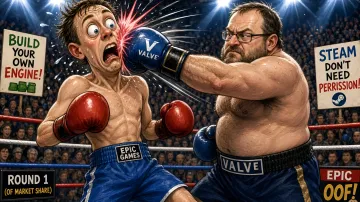
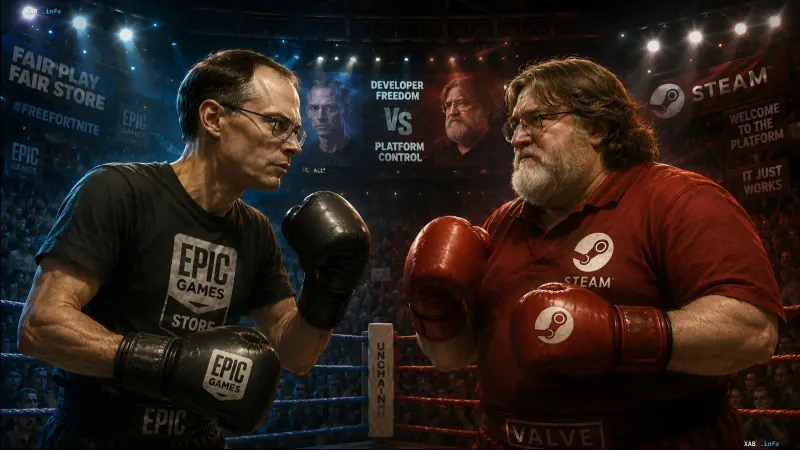
The discussion of the commission is especially acute against the backdrop of ongoing confrontation between major digital platforms. The visual image of this conflict—a literal 'boxing glove' between Epic Games and Steam/Valve—has become part of industry mythology, with each side positioning its distribution model as fairer for the developer. Epic Games has promoted a 12% commission model since launching its own store in 2018, arguing it 'returns value to developers.' Meanwhile, Steam maintains a 30% rate, relying on its mature ecosystem and audience scale. For studios in practice, the choice between platforms often comes down not to an abstract percentage, but to concrete numbers: how many players will actually see the game in recommendations, what backend services are available out of the box, and what the final margin is after deducting marketing and infrastructure expenses.
Conclusion: Commission as the Price for an Ecosystem
Thus, the question 'why pay 30% when you can sell yourself' requires an answer not in the plane of morality or 'platform greed,' but in the plane of real economics. Digital distribution is not file hosting; it is a comprehensive service: payment logistics, tax compliance, legal protection, technical backend, and marketing traffic. For a studio not ready to invest in replicating all these layers, the platform commission remains a rational price for access to a ready-made ecosystem. And until alternatives capable of offering a comparable set of services at a significantly lower commission appear on a sufficient scale, Steam's 30% rate and similar competitor terms will persist as a structural element of the gaming industry economy.