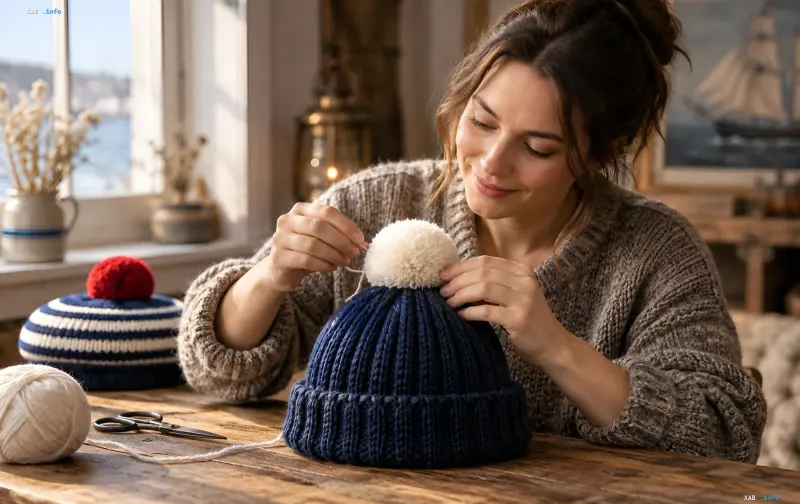
The pom-pom on a winter hat has long become such a familiar detail that most people never think about its origin. Meanwhile, this fluffy ball on the crown has a long history tied to naval service, military uniforms, and handicraft traditions. Some of the popular explanations for its appearance turned out to be mere legends, while others are supported by museum exhibits and archival documents. Let us explore why pom-poms were originally made and whether they serve a purpose today.
Military and Naval Roots of the Ornament
Pom-poms appeared on headwear long before modern winter hats. They were used to decorate traditional clothing and military uniforms, later transitioning into everyday fashion. One early example is Scottish military attire, where a small pom-pom on top of the hat was called a "toorie". The National Museums of Scotland house a Glengarry military cap with a red pom-pom, dating back to approximately 1799–1803. In military environments, such elements served not only as decorations: the appearance of the headwear, its colors, and insignia helped identify belonging to a specific unit.
The Legend of Head Protection on Ships
The most famous story about pom-poms is linked to sailors. The French Navy has used the traditional bâchi headwear with a bright red pom-pom since the 19th century. A popular explanation claims that the detail performed a protective function: the ceilings below the decks of old ships were low, and rough seas caused constant rolling, so the soft pom-pom was supposedly meant to cushion accidental head bumps against beams and protrusions. However, the French National Maritime Museum classifies the head protection story as a legend. The museum offers a simpler explanation: after finishing knitting the headwear, a thread remained, and styling it into a pom-pom was a convenient way to finish the work.
From Uniform to Everyday Fashion
Over time, pom-poms moved beyond military and naval uniforms to become part of everyday knitted headwear, including winter hats. The Metropolitan Museum of Art in New York holds an 1890 lithography depicting a winter hat with a large pom-pom. The detail was well-suited for handicraft: it could be made from leftover yarn, and the ornament itself transformed even the simplest solid-color hat. Later, various options appeared—small yarn balls, large fluffy pom-poms, and faux fur models.
Practical Sense in Modern Use
In modern winter hats, the pom-pom mostly performs a decorative function: it does not make the hat noticeably warmer nor does it provide impact protection. At the same time, the ornament retains some practical advantages mentioned by the publication, but in daily use it can sometimes be a hindrance: a bulky pom-pom can press against a car seat headrest or interfere with pulling up a hood.
A separate nuance concerns care. Large pom-poms, especially those made of faux fur, can lose their shape after improper washing. Therefore, before cleaning, it is worth checking the manufacturer's recommendations, and removable decorations should be washed separately if necessary. Thus, today the pom-pom is primarily an element of style and tradition inherited from naval and military headwear rather than a functional detail.