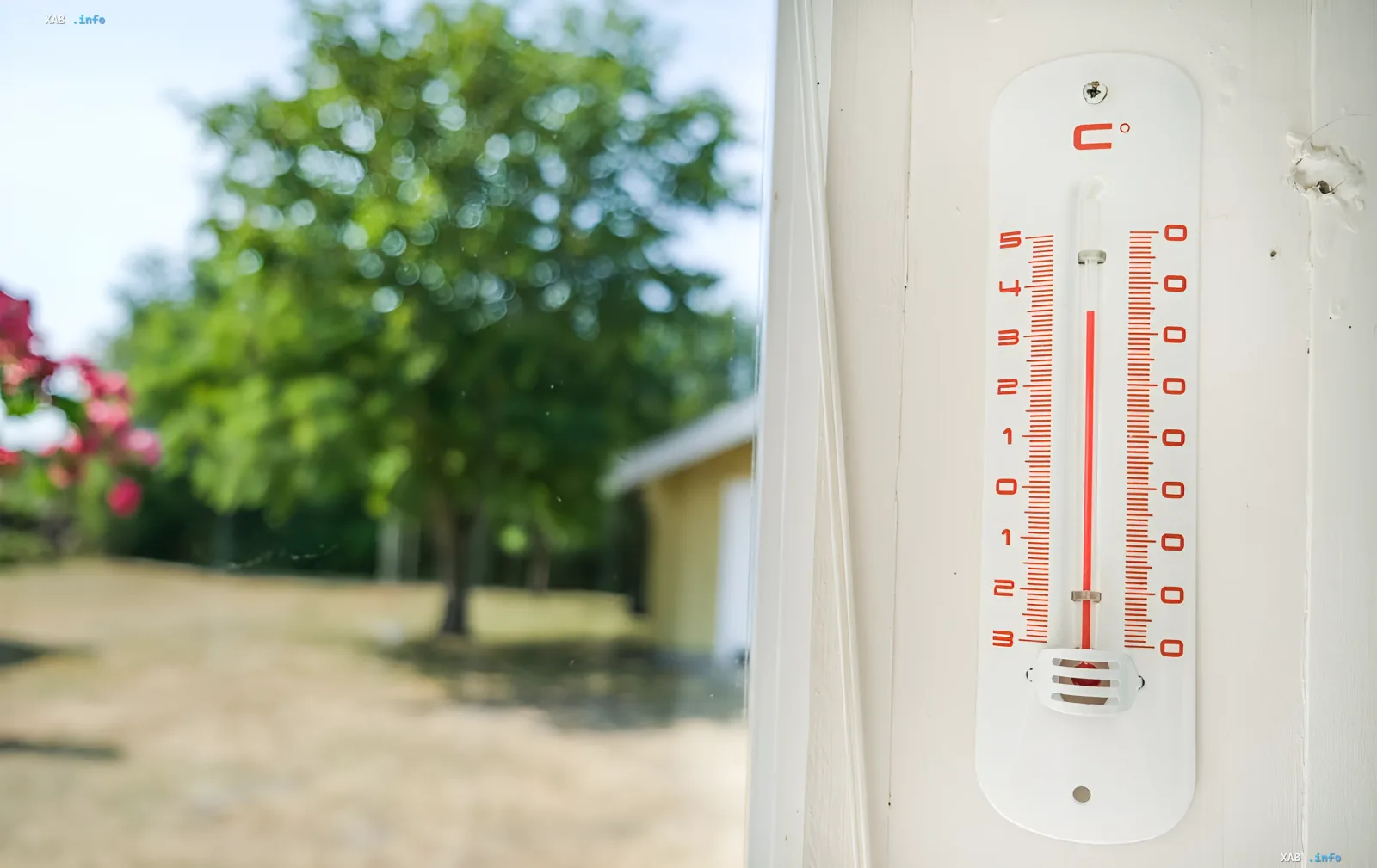
On hot summer days, sensational headlines about extreme temperatures often appear online. Social media is flooded with photos of home thermometers showing +40°C and above, even when official sources report no temperature records. This naturally raises the question: why do readings from instruments in an apartment or on a balcony differ so significantly from meteorologists' reports?
Experts from the Ukrainian Hydrometeorological Center (UkrGMC) explain this phenomenon using simple laws of physics. The difference in readings arises from how objects are heated by the sun.
The surface heating effect
On a sunny day, solar radiation heats the ground and various objects first: asphalt, concrete, metal structures, and house roofs. Experts from the Poltava Regional Center for Hydrometeorology note that these objects can heat up to temperatures significantly higher than the air temperature, and then release the accumulated heat into the environment.
Consequently, a home thermometer located in direct sunlight or near heated surfaces records not only the temperature of the air mass but also the thermal radiation from surrounding objects. This is why a device on a sunny balcony might show +45°C, while the actual air temperature is only +30°C.
Measurement standard: The Stevenson screen
To measure air temperature correctly, meteorologists worldwide use a special tool called a psychrometric (or meteorological) screen. This structure was proposed in 1864 by Scottish engineer Thomas Stevenson and has since become an international standard.
Despite rapid technological development, the design of the screen has hardly changed in a century and a half because it perfectly solves the task of protecting instruments from the sun and precipitation. At first glance, it resembles a small wooden "house on stilts," but every detail has an important functional purpose:
- Orientation: The screen doors traditionally open to the north, preventing direct sunlight from hitting the instruments during observations.
- Ventilation: Instead of solid walls, louvered grilles are used. Air passes freely through them, ensuring constant ventilation, while simultaneously protecting the instruments from the sun.
- Thermal insulation: Additional protection against heating is provided by a double roof with an air gap between its parts.
Why you can trust weather station data
Inside the psychrometric screen are instruments for measuring air temperature and humidity. Although modern automated weather stations increasingly use electronic sensors, the principle remains unchanged: measurements must be taken under conditions of free air circulation and protection from external influences.
All meteorological stations operate according to unified international requirements developed by the World Meteorological Organization. This guarantees that the temperature measured in one country can be accurately compared with observation results from any other point in the world. Furthermore, meteorological instruments are regularly checked and calibrated, which eliminates equipment errors.
Thus, if a home thermometer shows a significantly higher temperature than indicated in official reports, it is not a meteorologist's error. Most likely, your device is recording the influence of sun-heated surfaces and direct rays, rather than the true temperature of the air mass.


