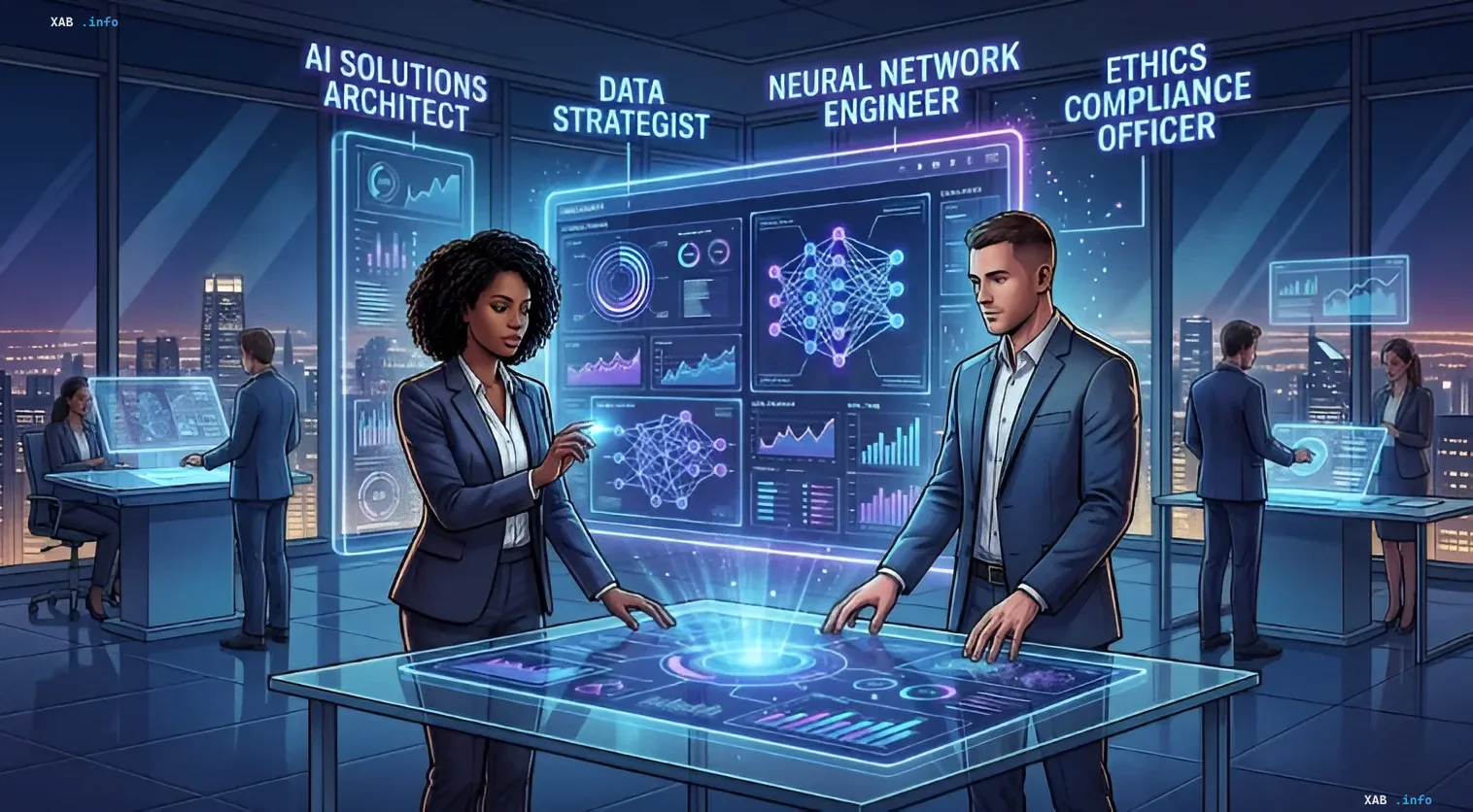
The global labor market in 2026 is undergoing a structural shift comparable in scale to the transition from an industrial to a post-industrial economy. According to a Lloyds Banking Group report, as well as aggregated data from leading recruitment agencies, the corporate sector is not merely optimizing headcount — it is generating sustained demand for categories of specialists that did not exist in standard headcount structures just three years ago. At the same time, according to a klerk.ru publication, around 95% of companies face a chronic shortage of qualified personnel, exacerbated by competition for a limited pool of specialists and rising salary expectations. Logistics.ru notes that the absolute number of job openings is declining, yet the structural shortage in key competencies persists, indicating a redistribution rather than an overall contraction of demand.
Enterprise Prompt Engineer: From Hype to Institutional Role
The Enterprise Prompt Engineer position, which many HR directors in 2023–2024 viewed as a temporary analytical phenomenon, has by mid-2026 become an established role in the headcount structures of large corporations. The role's function centers on the development, testing, and industrial deployment of standardized text scenarios for interacting with large language models (LLM). The specialist's practical task is to build automated workflows that enable AI systems to generate code, legal documents, or process customer requests with predictable quality, without repeated iterations. The economic rationale for hiring stems from the fact that the chaotic use of generative tools by line staff generates significant transaction costs: the time spent "calibrating" a prompt far exceeds the cost of an automated pipeline designed by a qualified specialist.
AI Ethics and Compliance Officer: The Regulatory Driver
The growing demand for AI ethics and compliance specialists (AI Ethics & Compliance Officer) directly correlates with the entry into force of regulatory acts governing the use of artificial intelligence. In the European Union, the EU AI Act is operationally in effect, while similar legislative frameworks are being formed in the United States and the United Kingdom. The role's function includes auditing deployed AI systems for compliance with personal data protection requirements, the absence of discriminatory patterns in algorithmic decisions (including in candidate selection and credit risk assessment), and the prohibition on using copyright-protected data. For the corporate sector, the key hiring motive is the minimization of financial risks: fines for regulatory violations linked to model "hallucinations" and data leaks through neural network interfaces have reached levels that make preventive compliance economically rational.
AI Solutions Architect: The Infrastructure Level of Decision-Making
The AI Solutions Architect role occupies the top level in the hierarchy of AI specializations. The specialist evaluates the enterprise's business processes and determines which specific technologies and from which vendors should be integrated into the corporate infrastructure. According to industry surveys cited in analytical reports, around 60% of mid- and large-business executives assess the risk of losing competitiveness without an AI strategy as critical. The architect serves as a translator between strategic management and engineering teams: the abstract requirement to "deploy neural networks" is converted into concrete technical specifications with budgetary frameworks and performance metrics. This position requires interdisciplinary competence, combining an understanding of business processes, the maturity of the AI stack, and the principles of corporate IT architecture.
Data Annotation and Model Training Expert: The End of the Low-Quality Annotation Era
The model of training neural networks based on the mass engagement of non-specialist annotators through freelance platforms has lost its viability for tasks beyond basic classification. To train specialized AI models in medical, legal, and financial domains, corporations engage practicing professionals from the relevant industries who verify generative outputs, build reference datasets, and correct algorithmic errors within the RLHF (Reinforcement Learning from Human Feedback) methodology. The market driver here is that general-purpose generative models do not provide sufficient accuracy for regulation-sensitive tasks, while the alternative — fine-tuning on domain data with human oversight — requires precisely such specialized expertise.
AI Security Manager: A New Vector of Cyber Threats
As the share of AI components in corporate processes grows, a class of threats is emerging that is not covered by traditional information security protocols. These include prompt injection (the introduction of malicious instructions via user input), circumvention of algorithmic filters, extraction of proprietary data from model weights, and manipulation of reasoning chains (chain-of-thought). An AI security specialist (AI Security Specialist / Red Teamer) designs and conducts penetration testing specifically for these vectors. The economic rationale for the role is determined by the fact that the compromise of a corporate AI infrastructure entails not only direct financial losses but also a breach of data protection obligations to regulators and business partners.
Contradictory Data
When comparing sources, a discrepancy is noted in the assessment of the scale of the personnel shortage. According to klerk.ru, 95% of companies are unable to fill their existing vacancies, indicating a systemic hiring crisis. At the same time, logistics.ru reports a decline in the absolute number of posted vacancies, while acknowledging the persistence of a structural shortage. The difference is explained by differing methodologies: the first source records the share of companies experiencing difficulties, while the second tracks the dynamics of the vacancy market volume. In the context of AI specializations, additional complexity arises from the lack of a unified role classification: the same function (for example, data verification) is designated as a separate position in some companies, while in others it is distributed across multiple roles, making direct headcount comparisons difficult. The claim that 60% of companies assess the risk of lacking AI as critical is cited in an analytical article with reference to "industry surveys" without naming a specific research center, which limits the verifiability of this figure.
Analytical Summary and Long-Term Consequences
The totality of the described trends indicates that the transformation driven by AI adoption does not reduce to the replacement of routine functions. The observed pattern is a redistribution of demand toward roles requiring a synergy of specialized industry expertise, an understanding of algorithmic principles, and regulatory compliance competencies. For the corporate sector, this means a growth in permanent operating expenses for staffing the AI infrastructure; for the labor market, it means the formation of a sustained shortage at the intersection of disciplines, which, given the current dynamics, will not be compensated within the next two to three years. For job seekers, the practical conclusion is unambiguous: investment in interdisciplinary qualifications, combining subject-matter expertise with a functional understanding of AI tools, forms the most resilient human capital under current market conditions.