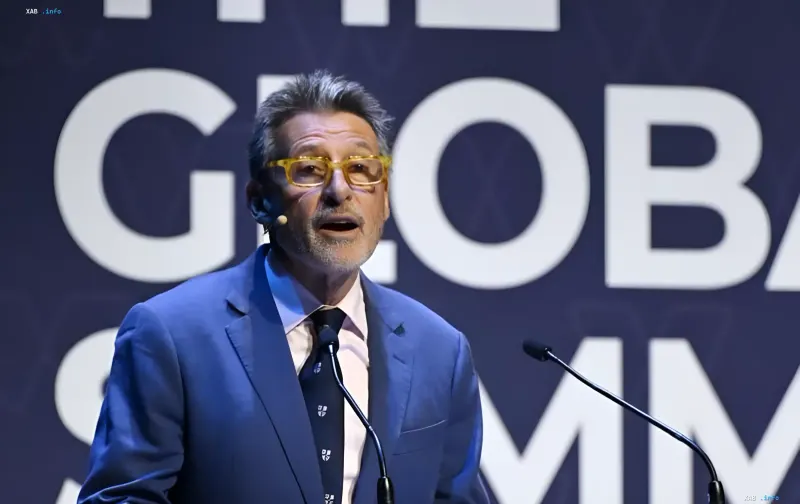
On the eve of the launch of the first-ever Absolute World Athletics Championships, to be held in Budapest on 11–13 September 2026, World Athletics president Sebastian Coe publicly confirmed that the federation is not considering the return of Russian and Belarusian athletes to international competitions. The official's statement was made in an interview with the Ukrainian outlet Suspilne Sport and was carried by Ukrainian media, including Sport RBC.UA. Thus, World Athletics remains one of the few sports federations to maintain a full ban on representatives of the aggressor states since the start of the full-scale invasion of Ukraine.
The federation's position has not changed
Commenting on the current status of the restrictions, Sebastian Coe emphasized the organization's unwavering course. "Our position has not changed. The people of Ukraine know the position of World Athletics, and we stand by it — we believe this best serves the best interests of the sport and its integrity," stated the head of World Athletics. These words sound like a direct response to the growing pressure in favor of easing sanctions, which has intensified in recent months amid discussions about admitting individual athletes in a neutral status.
Reaction to IOC recommendations
Separately, Coe commented on the updated recommendations of the International Olympic Committee, which advised easing the restrictions and admitting athletes in a neutral status. According to the federation's president, he does not feel pressured by such an IOC recommendation. This statement highlights the persistent gap between the position of the Olympic leadership and a number of national federations leaning toward pragmatic admission, and the hard line of World Athletics, which places the integrity of sport above sports pragmatism.
The Absolute World Championship in Budapest
Besides political topics, Sebastian Coe shared his expectations for the new elite event — the Absolute World Championship, which on 11–13 September will bring together the world's top athletes in Budapest, Hungary. "Athletes who go to competitions are nervous. If they are not nervous, then probably they will not perform as well. So I am nervous, because this is something new. I am confident in the tournament, because I know that our teams have done everything possible to make this the best experience. I think this is the beginning of a completely different approach in our sport," he noted. It is worth noting that the winners of this championship will receive exclusive awards rather than traditional medals, which underscores the innovative format of the competition.
Contradictory data
Publications on the topic show a difference in the framing and assessment of the federation leadership's actions. Ukrainian outlets (Sport RBC.UA, Obozrevatel) present Coe's statement in a neutral-informational manner, emphasizing the maintenance of the ban and confidence in the tournament. At the same time, the Russian outlet mk.ru, in an article dated 26 July 2026, uses a confrontational frame, calling Coe a "veteran bureaucrat" and discussing whether a court can pressure World Athletics "if the IOC failed" to do so. Thus, one side presents the federation's position as a balanced decision in the interest of sport, while the other — as an example of politicized pressure to which, in its version, a judicial mechanism may respond. In addition, there is an objective contradiction between the IOC's recommendation to ease the restrictions and World Athletics' refusal of it, which makes the picture of the admission of Russian and Belarusian athletes far from unambiguous.
The outcome of Sebastian Coe's statement is the confirmation that, as of the start of the Absolute World Championship in Budapest, Russian and Belarusian athletes remain outside international starts under the auspices of World Athletics. For the Ukrainian side this is perceived as support, while for the Russian side — as a continuation of isolation, which makes the topic one of the key political stories in athletics in 2026.