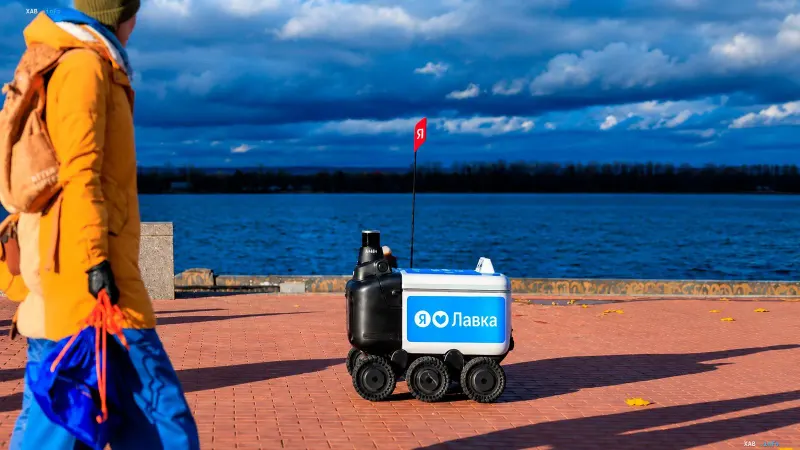
On November 26, 2026, Yandex Lavka launched in Samara — and this event became a turning point for the entire network. For the first time, the service began operating in a new city simultaneously with robotized delivery: on the day the dark stores opened, the rovers were already fulfilling their first orders. The company consciously abandoned the previous sequential model, in which locations with courier delivery were opened first and robots were connected later, as the infrastructure was built up. This approach became possible thanks to the start of serial production of fourth-generation rovers, which made it possible to set up a "turnkey" launch from day one.
A new format for entering a city
Previously, the logic of Lavka's expansion was built on a two-stage scheme: first, couriers came to the city and dark stores were opened, and robotized delivery was connected some time later, after the necessary infrastructure and data had accumulated on the ground. Samara became the first city where both stages merged into one. This shortens the time to full coverage by robotized delivery and reduces the load on the courier network from the very start. In essence, the company is moving the "robotized" experience from pilot cities into the standard launch scenario.
Fourth-generation rovers: what changed technically
The key condition for the new format was the start of serial production of fourth-generation rovers. Compared to previous versions, the machine received an updated suspension, a more powerful computing unit, and a new lidar. The combination of these changes improves resilience to uneven surfaces, expands the computing capabilities of the onboard equipment, and enhances the quality of building a picture of the surrounding space. It is precisely serial, rather than one-off, production that allows robots to be launched in new cities in sync with the opening of dark stores, rather than waiting for a fleet to accumulate.
Mapping robots and the AI planner: how the robots "see" the city
Before the rovers head out on their routes, special mapping robots survey the city's streets. They collect data on roads, sidewalks, and urban infrastructure and produce detailed maps on which the delivery rovers subsequently operate. While moving, the machine relies on cameras and lidars, assessing the situation and choosing a route. Since spring 2026, trajectory calculation has been handled by an AI planner, which helps respond faster to changes around and reduces delivery time. Thus, behind the "seamless" launch in Samara stands a combination of three elements: precise preliminary mapping, real-time sensory perception, and intelligent route planning.
Scale: figures that show acceleration
At present, Yandex's robot delivery operates in 15 cities. Since the beginning of October 2026, the number of dark stores equipped with rovers has grown 2.2-fold — to 282. In November, the robots fulfilled up to 15,000 orders per day. In the third quarter of 2026, the rovers completed more than 750,000 deliveries for Yandex services and partners — almost three times more than in the previous three months. These figures indicate that robotized delivery has moved from the stage of point pilots into a phase of rapid scaling, and the launch in Samara is a logical continuation of this dynamic.
What this means for the market
The shift to simultaneous launch of the service and robot delivery changes the competitive frame: the time between opening a location and reaching robotized delivery is compressed to zero. For consumers in new cities, this means access to automated delivery from the first day of Lavka's operation, and for the company — the ability to faster tailor the operational model to a specific city. With the fleet of dark stores with rovers growing 2.2-fold in a month and a multiple increase in delivery volume across quarters, Samara becomes not just a new city in the network, but an indicator that robotized delivery has become a standard, rather than experimental, element of Yandex Lavka's strategy.