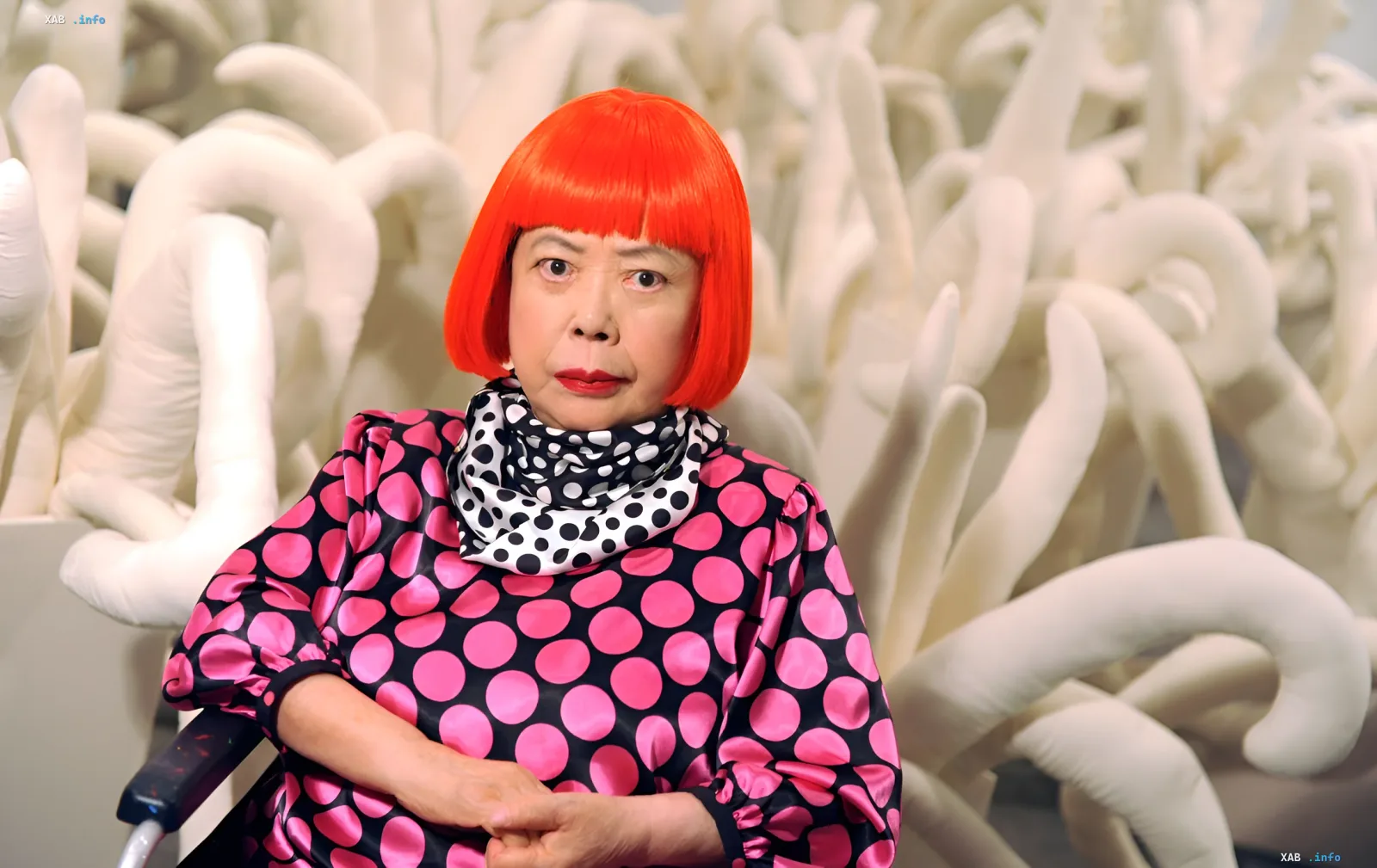
The renowned Japanese artist Yayoi Kusama has died at the age of 97. This was announced on August 14, 2026, on the artist's official website: she passed away in one of Tokyo's hospitals. Kusama went down in history as one of the most recognizable figures in contemporary art — her surreal canvases, installations, and street works featuring infinite dots, brushstrokes, and repeating motifs create hypnotic optical illusions and are instantly recognizable at first glance.
A Visual Language That Is Impossible to Mistake
Kusama's style is built on contrast: small dots and lines, serial repetitions, acid colors, and giant polka-dotted pumpkins combine in works that are equally easy to recognize on canvas, in sculpture, or in body art. The artist worked in a wide range of media — from painting to street art — and achieved true cult status: her canvases sell for millions of dollars, and her exhibitions draw thousands of visitors. The pinnacle of her installation language was the 'Infinity Mirror Rooms,' where mirrors, light, and repeating dots create the illusion of infinite space; over a career of more than sixty years, she created dozens of such rooms with different content.
A Childhood That Became the Source of Hallucinations
Kusama's life path directly shaped her art. She was born in 1929 into a wealthy but patriarchal and conservative family that owned a plant nursery. According to her own recollections, her mother did not love her and disapproved of her passion for drawing, striving to raise a 'model wife,' so a career in art was out of the question in the family. Throughout her life the artist suffered from hallucinations: dots, lines, and repeating motifs were superimposed on everything she saw. She linked them in part to childhood stress and later noted that creativity became her salvation: 'I followed the thread of art and found a path that would allow me to live.'
Emigration to the USA and the Struggle for Recognition
In 1957, Kusama had a final falling-out with her family and moved to the USA: her mother gave her money in exchange for a promise never to return. The young artist had hoped for more opportunities in a 'progressive' country, but was quickly disappointed by the total dominance of men in the art world of the 1960s–1970s. Her serial repetitions externally echoed the works of Andy Warhol, while her predominantly phallic-shaped fabric sculptures — the work of Claes Oldenburg. Kusama believed that it was her male colleagues who borrowed her ideas and visions, although this is impossible to establish with certainty.
Return to Tokyo and Life Beside the Clinic
In the 1970s, the artist voluntarily returned to her homeland and settled in a psychiatric clinic in Tokyo. She continued to create actively: her studio was located near the hospital, and after work she returned to her ward. It was during this period, despite her isolation, that the part of her legacy which later brought her world fame was formed.
Global Recognition and Legacy
The peak of international recognition came in 1993, when Kusama was invited to the Venice Biennale, where she became the first woman to represent the national pavilion of Japan. This event was a turning point in her career and triggered a wave of global interest. Today, the name Yayoi Kusama is one of the most outstanding in contemporary art, and the Kusama Museum operates in Tokyo — a five-story gallery where exhibitions change several times a year, and tickets are sold only online and in advance.