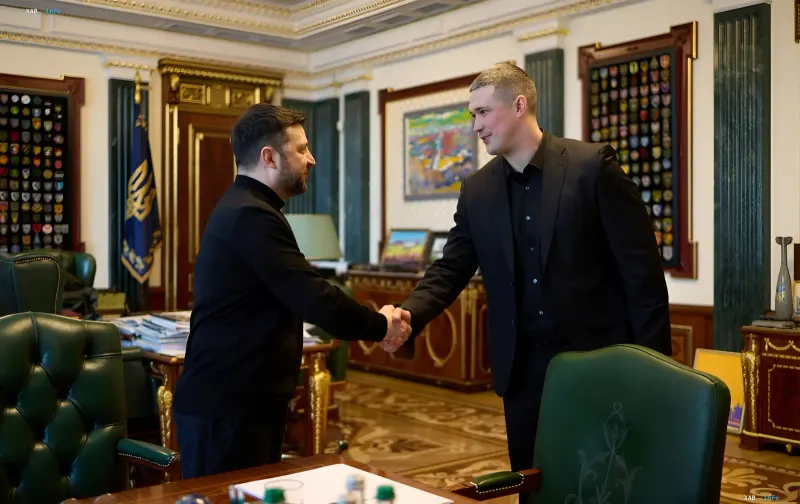
Ukrainian President Volodymyr Zelensky, during a meeting with journalists, spoke in detail about the inner workings of the personnel reshuffles in the defense bloc that led to the resignation of Defense Minister Mykhailo Fedorov. The head of state acknowledged that behind the high-profile decisions lay a protracted conflict between the Ministry of Defense and the military command, in which, according to him, questions of the distribution of powers, bureaucratic standoffs, and personal ambitions became intertwined. Zelensky emphasized that before dismissing Fedorov, he four times offered the former minister options to continue working in the presidential team, but the latter declined all of them.
The "Ministry of War": the presentation Zelensky ordered to be forgotten
According to the president, even at the very beginning of Fedorov's tenure as minister, there was a verbal agreement between them on a clear division of zones of responsibility: the Ministry of Defense provides the army with resources, while the military command manages the troops and conducts operations. However, as Zelensky recounted, Fedorov subsequently prepared a presentation on the creation of a so-called "ministry of war," under which the Chief of the General Staff would in fact be subordinate to the Ministry of Defense. "I called him right at the start and said: 'A ministry of war, when there is no Commander-in-Chief, and the Chief of the General Staff is in fact under you — forget this presentation,'" RBC-Ukraine quotes Zelensky as saying. According to him, Fedorov replied that he had heard the president's position, but then began looking for workarounds to implement a similar model of control over the military command.
Bureaucratic standoff and the offer to "honestly fire both"
Zelensky described the escalation of the conflict: the military command, he said, began responding to the Ministry of Defense's actions with its own bureaucratic decisions, creating a closed loop of mutual sabotage. On the eve of the personnel decisions, before the president's meeting with parliamentarians, Fedorov, according to Zelensky, stated outright: "Well, then let's honestly fire both of them." The president confirmed that a decision would be made, but "sequentially" — he did not want to change both the defense minister and the Commander-in-Chief of the Ukrainian Armed Forces simultaneously amid a full-scale war. Separately, Zelensky noted that two weeks before the final decision he had offered Fedorov and Oleksandr Syrskyi to meet and reach an agreement on their own, but the meeting did not take place. "You cannot let it come to a conflict when they are not even talking to each other, and then both of them say there was no conflict at all," the president concluded.
Four offers and four refusals
Zelensky stated that he harbors no negativity toward Fedorov and highly values his contribution, especially in the area of digitalization of the defense establishment. "I really had and have a very positive attitude toward Mykhailo. We have been through a lot together. But I believe that he is going — whether he is being pushed — into the wrong things," the president said. According to him, after the dismissal he four times offered Fedorov various options for further work in the team, but the former minister declined each one. "Mykhailo refused all four offers. Well, that is his choice," Zelensky summed up, without revealing the specific content of the offers.
Contradictory accounts
There is a notable discrepancy between Zelensky's and Fedorov's own versions in interpreting the reasons for the resignation. The president interprets the situation as a systemic conflict between the Ministry of Defense and the military command over overlapping powers and Fedorov's attempts to subordinate the Chief of the General Staff to himself. Fedorov himself, explaining the reasons for his resignation, stated that it was not about a conflict with Syrskyi, but about increased pressure following changes in the work of the Ministry of Defense, in particular in the area of defense procurement and tenders. Thus, one side sees the root of the problem in institutional confrontation and the minister's ambitions, while the other — in external pressure on procurement processes. Both versions were stated publicly and have not been refuted by either side.
Context: not a "devil," but part of a collective effort
Separately, Zelensky commented on the criticism directed at the military command, urging not to reduce the assessment of the army's work to individual personalities. He acknowledged that Syrskyi "had issues," but reminded of the military operations and successes associated with his command. "He is certainly not a 'devil.' Likewise, Mykhailo has his own victories — and serious ones. Especially in digitalization," the president stated. He emphasized that behind the military operations stand significant efforts, risks, and the losses of a large number of people, and that one cannot say that one leader is strong only in the presence of a specific minister. "This is not something one person does, and it is not one person's merit. And this must be respected," Zelensky concluded.