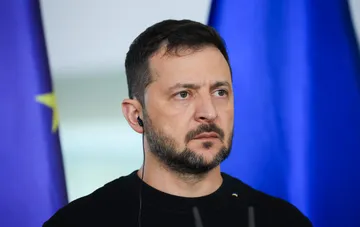
Ukrainian President Volodymyr Zelenskyy stated that Kyiv has managed to weaken Russia's strategy of striking data infrastructure and cyberspace thanks to technological superiority and the decentralized architecture of digital systems. The head of state announced this in an interview cited by The Sun and reported by RBC-Ukraine. According to Zelenskyy, the Russian military has systematically attacked Ukrainian data centers and cyber infrastructure elements for a long time, but these strikes have not paralyzed communications and the internet in territories controlled by Kyiv.
Decentralization as an Element of National Defense
Zelenskyy named the decentralized and developed data architecture as the key factor that allowed Ukraine to withstand waves of attacks on its digital infrastructure. "The Russians have attacked our data centers so many times, but we still had mobile communications and the internet. Because we have a decentralized and developed digital infrastructure," the president explained. He emphasized that it was precisely the technological maturity and distributed nature of the systems that made it possible to maintain communication operability even with direct physical destruction of individual nodes.
Retaliatory Strikes and Vulnerability Asymmetry
Zelenskyy also pointed to an asymmetry in the vulnerability of the two countries' digital infrastructure. According to him, Ukraine's retaliatory strikes against Russian facilities hurt Moscow harder because Russia's digital architecture is built on a centralized model. "Our retaliatory strikes are more painful for Russia because everything is more centralized for them," the president stated. Thus, decentralization, initially conceived as a protective mechanism, has turned into an instrument of asymmetric impact on the adversary.
Air Defense Shortage and Survival Strategy
Answering a question about the reasons for decentralization, Zelenskyy directly pointed to a shortage of air defense systems. "We don't have that much air defense — we have a deficit. That is why we decentralized everything, not just data," he noted. The president stressed that Ukraine adheres to a defensive doctrine: retaliatory actions are taken exclusively after Russian attacks. "We always try to respond and do so only after Russian attacks against us," Zelenskyy summarized, distinguishing Kyiv's tactics from Moscow's strategy, which, in his assessment, relies on the massive deployment of air defense to protect existing facilities.
Context: Attacks on Digital Infrastructure and International Analysis
Zelenskyy's statements came against the backdrop of ongoing Russian strikes on Ukraine's critical infrastructure, including communication and energy facilities. Earlier, American analysts published assessments explaining Moscow's motivation in systematic attacks on Ukrainian data centers, linking them to attempts to destabilize civil society and undermine trust in state institutions. Kyiv, in turn, has in recent months strengthened the protection of data centers and facilities of critical importance for the functioning of communications, which, according to Ukrainian authorities, has reduced the effectiveness of Russian strikes on these targets.
Significance of Statements for Understanding the Digital Dimension of the Conflict
Zelenskyy's interview marks an important shift in Kyiv's public discourse: digital infrastructure is being discussed at such a level for the first time as an independent theater of military operations rather than an auxiliary element. The recognition that decentralization has become not only an engineering solution but also an element of military doctrine emphasizes that the conflict between Ukraine and Russia has gone beyond kinetic strikes and transitioned into a sustained confrontation in cyberspace, where system architecture determines a state's resilience to hybrid attacks.