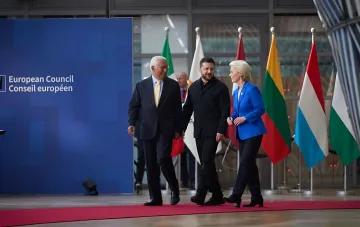
At a briefing in Brussels, Ukrainian President Volodymyr Zelenskyy commented on the international intelligence cooperation format built around Kyiv during the war. According to him, «many countries — we are talking about dozens of countries» share intelligence data with Ukraine, and such work has been established over the period of hostilities. The head of state called this assistance «very substantial and serious», emphasizing the scale of the coalition providing Kyiv with intelligence support.
Ballistic data from the US
Zelenskyy separately highlighted the channel through which Ukraine receives information on ballistic missile launches. «As for ballistic missiles, specifically data on ballistic launches, we receive this information from the United States of America. As you can see, there are many challenges specifically related to ballistics», he stated. Thus, within the structure of multinational exchange, the American side is responsible for a critically important segment — fixing ballistic missile launches, according to the president.
Striving for independence
Commenting on the dependence on external intelligence channels, Zelenskyy noted that Ukraine is «working on all capabilities to be as independent as possible». At the same time, he recalled that Kyiv «has always thanked American partners for intelligence data», linking the current cooperation with the interaction practice accumulated during the war.
European contribution to data sharing
The context of the European component of intelligence sharing was clarified by French Foreign Minister Jean-Noël Barrot, who stated that two-thirds of intelligence from Western partners comes from Europe. He also urged not to succumb to Russian propaganda, which, according to him, is trying to undermine support for Ukraine. These statements complement the picture where European and American channels form a joint system but are responsible for different types of data.
The shadowy side of data sharing
Against the background of statements about gratitude and expanded cooperation, RBC-Ukraine previously reported that U.S. intelligence threatened the Ukrainian embassy to stop data sharing if Kyiv continued to attack Russian energy facilities. According to The Washington Post, such words were voiced on October 12, though the threat has not yet been carried out. The combination of these reports indicates that the format of intelligence exchange between Kyiv and Washington remains a subject of internal coordination and may be adjusted depending on the nature of Ukrainian strikes.