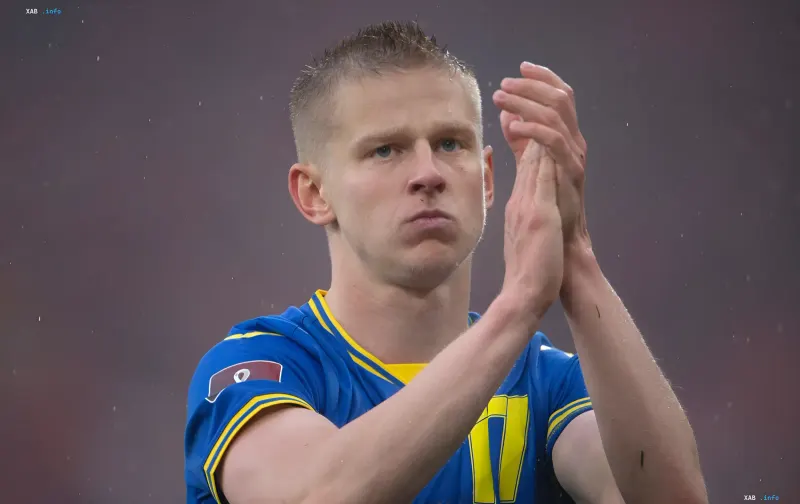
In an op-ed for Sport RBC.UA, journalist Daniil Vereitin explores which career paths seem organic for Oleksandr Zinchenko after one of the most difficult periods in his football biography. The author immediately notes that he is not a fan of the player—his perception was influenced by the controversial departure from Shakhtar in 2014 and a short personal conversation in May 2018—but he calls denying the midfielder's talent amateurish: according to him, Zinchenko remains a strong, versatile, and experienced player capable of helping any team.
Injury at Ajax and forced break
Currently, according to the author, the 29-year-old midfielder is going through a tough stretch. A year ago, he left England after a failed attempt to settle at Nottingham Forest, then chose Ajax, where he was supposed to play for half a year until the end of the 2025/2026 season. However, in his very first match for the Amsterdam club, Zinchenko suffered a serious knee injury, which, according to Vereitin, crossed out both the opportunity to prove himself in Amsterdam and the very possibility of playing football in 2026. In recent weeks, positive signals have emerged: Ajax has allowed the footballer to train at the club's base, which gave some of the author's circle hope to see Zinchenko back in the training process at least.
PSV as a logical and motivating step
Vereitin recalls that Zinchenko's major European career began at PSV Eindhoven, where he went on a loan agreement between the Dutch club and Manchester City. For the author, this is not just a strong club with constant Champions League participation, but also a source of personal motivation—to "make the people at the Philips Stadion happy." Referring to Zinchenko's book, the author describes how in 2016/2017, the 19-year-old player ended up on loan at the last minute, received a national team call-up, and did not have time to adapt, while rumors that the sporting director, not head coach Phillip Cocu, wanted him at PSV further destabilized his state. In the present, Vereitin believes that Peter Bosz is unlikely to refuse a player with top-level experience as a left-back whose best qualities manifest in the center of the field; PSV, according to his data, leads the league table at the time of writing, and the club could use a reliable bench.
The Spanish connection and Valencia
A separate block of the column is devoted to the Spanish direction. Vereitin emphasizes that at the professional level, Zinchenko worked most with Spanish specialists—Pep Guardiola at City and Mikel Arteta at Arsenal—and he has no mental issues with such coaches. The most obvious Spanish team that, in the author's opinion, will change its squad in winter looks to be Valencia: for such a club, 19th place in the championship looks like a fiasco. Recently, rumors sent Artem Dovbyk to Valencia, who, in case of a move, would have to compete for a spot in the starting lineup with local favorite Hugo Duro. At the same time, Vereitin argues that Zinchenko looks stronger than potential competitors both on the left flank, where Jose Gaya and Jesus Vazquez are named, and in other positions he considers in the context of reinforcement.
The book "Believe" and the author's personal view
A significant part of the column is occupied by the author's reflection on Zinchenko's biographical book "Believe," gifted by an old friend serving in the Armed Forces of Ukraine—which Vereitin calls a light trolling in light of his previous critical statements. He notes that the book is aimed at a European reader and carries themes about United24 and the importance of helping Ukraine, which he says are important and correct, but interesting details of his playing career are also hidden behind them. Personal impressions, the author emphasizes, are an individual matter, and that is precisely why he suggests looking at the situation with Zinchenko through the prism of facts and sports logic, rather than through the prism of sympathies.
The conclusion of the column is that it is too early to put an end to Oleksandr Zinchenko's career: he has the experience of top clubs, versatility, and familiar coaching schools, and the options for continuing—from returning to PSV to Spanish clubs like Valencia—look viable. Whether he will remain at Ajax on a new contract, the author does not know directly, but believes that for a 29-year-old player with such a background, the market and club facilities continue to remain open.