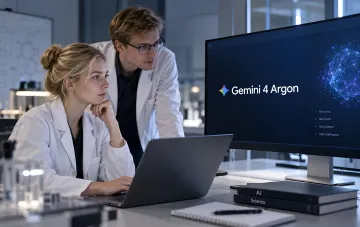
Google has officially introduced its flagship next-generation language model, Gemini 4 Argon. The announcement, made by Koray Kavukcuoglu, Senior Vice President of Google DeepMind and Chief AI Architect at Google, marks a qualitative leap in processing complex long-running processes, large-scale code refactoring, and analyzing massive data arrays.
Technological Breakthrough and Output Tokens
The primary technical feature of Gemini 4 Argon is an unprecedented increase in the output token limit to a record 1 million tokens, compared to 64 thousand in previous versions. This volume allows the model to conduct deep distributed computations and execute large-scale tasks within a single prompt. Thanks to its multimodal capabilities, Argon has topped key industry benchmarks, including DeepSWE v1.1 with 77.9% in real code engineering and AutomationBench.
Practical Application in Google's Ecosystem
The model has already been integrated into the tech giant's internal infrastructure, showing impressive efficiency. Engineers utilized Argon to optimize quantum algorithms, improving resource utilization baselines by 40% in minutes. Autonomous AI agents also identified and resolved memory leaks in data centers, freeing over 300 TiB of space. Furthermore, in the libgav1 library, Argon rewrote 32,000 lines of SIMD code, accelerating the video decoder by 2.7x.
Cybersecurity and Safety Precautions
Developers placed special emphasis on defensive capabilities. Gemini 4 Argon can autonomously discover and remediate critical software vulnerabilities, as validated during Wiz's Scan for Good initiative. To prevent abuse in creating biological/chemical weapons or conducting cyberattacks, Google implemented a multi-layered containment system under the Frontier Safety Framework, protecting against prompt injections in secure sandboxes.