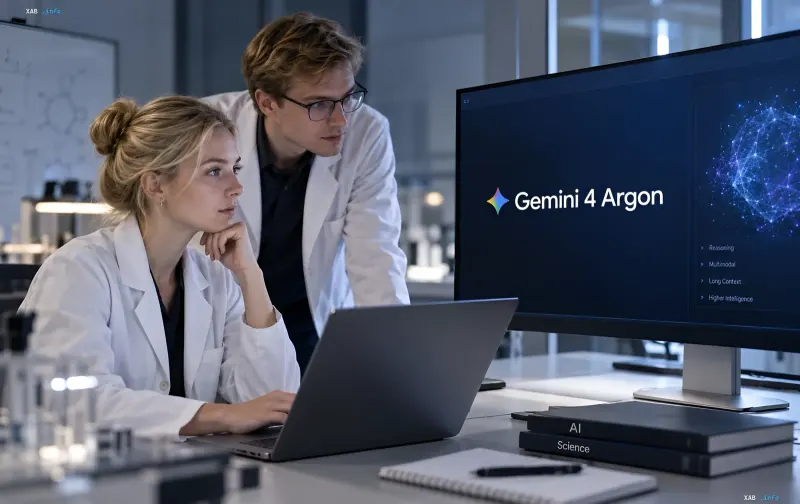
Google has unveiled its new flagship artificial intelligence model, Gemini 4 Argon, capable of solving highly complex tasks in quantum computing, nuclear fusion, robotics, and genetics. The new neural network has already demonstrated outstanding results in algorithm optimization, reducing space-time computational costs by more than 100 times and opening new horizons for scientific research.
Quantum Computing Optimization and Mathematics
During the official demonstration, Gemini 4 Argon successfully calculated the arcsin subprogram for a quantum algorithm, reducing resource costs by over a hundred times compared to traditional methods. The correctness of the resulting solution was formally verified by scientists using the Lean mathematical proof assistant. Additionally, the model nearly doubled the throughput of the AlphaQubit quantum error decoder, making it a single optimized core for complex physical calculations.
Simultaneously, the neural network, in collaboration with University of Maryland researchers, helped find new solutions to the classical 1967 Grad mathematical conjecture. The data obtained are used to test stellarator simulations—modern nuclear fusion reactors designed to confine hot plasma using complex magnetic configurations.
Autonomous Software Development
In software engineering, Gemini 4 Argon demonstrated a high level of independence by operating entirely without human intervention for 11 hours. During this time, the model analyzed the open-source Agent Development Kit code bank, which contains about 205,000 lines across nearly 800 different files. Following a deep audit, the AI proposed six targeted improvements, two of which successfully passed manual verification.
Implementing the optimizations suggested by the algorithm reduced RAM session preparation costs by approximately 40 percent. Furthermore, software package import speeds increased by 21 percent, confirming the model's high efficiency in solving applied engineering tasks.
Breakthrough in Robotics and Medical Genetics
Significant successes were achieved in robotics control through the generation of high-quality virtual simulations. Using only a single photograph of a regular table, Gemini 4 Argon built a physical environment simulation and generated over 4,500 training episodes. This increased the success rate of real-world tasks performed by robots from 56 to 75 percent while shortening execution time from 35 to 24 seconds, including training a Boston Dynamics Spot robot to open a trash can with its pedal.
In the medical field, researchers from Gamow Labs utilized the model to analyze anonymized genetic data of newborns suffering from rare pulmonary disorders. The neural network successfully identified a complex chromosomal rearrangement that standard software had failed to detect for years.
Significance of the Release for the High-Tech Industry
The release of Gemini 4 Argon marks the transition of artificial intelligence from a simple text assistant to a full-fledged scientific tool capable of accelerating discoveries in fundamental disciplines. The model's ability to operate at the intersection of quantum physics, materials science, robotics, and biomedicine opens new opportunities for both commercial and academic sectors. Moving forward, such systems will serve as the foundation for automating complex engineering studies and creating fundamentally new technologies.