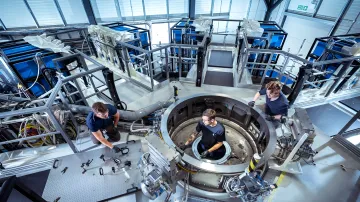
Physicists from the U.S. Department of Energy's Princeton Plasma Physics Laboratory (PPPL) have published the results of a computational study in the journal Physical Review Letters that could reshape the approach to designing future fusion power plants. The team, comprising Luis Delgado-Aparicio, Masayuki Ono, and Jonathan Menard, demonstrated that to achieve fusion ignition—a state where fusion reactions within the plasma release enough energy to sustain its high temperature without continuous external heating—it is more efficient to heat the plasma first and then increase its density, rather than the reverse. The work is currently purely theoretical: the proposed sequence has not been tested in an experimental reactor, but the calculations could significantly influence the choice of design parameters for new facilities.
The Lawson Criterion and Four New Factors
The model is based on the Lawson criterion, a set of conditions developed in the 1950s that describes whether plasma can remain hot and dense long enough to sustain a fusion reaction without additional external heating. The researchers expanded the classic formula by uniting four factors affecting the plasma's energy balance in a single model for the first time: helium accumulation as a reaction product, plasma contamination from interior reactor wall materials, energy losses from electron synchrotron radiation in magnetic fields, and heat leakage from the plasma. Each of these effects has been studied individually in the past, but their combined impact on ignition conditions has only now been evaluated. The scientists also analyzed the so-called Cordey pass—the boundary region between plasma requiring external heating and plasma capable of sustaining the reaction on its own.
The Tungsten Problem and Wall Design
The calculations revealed a potentially critical issue involving tungsten. This metal is being considered as a primary material for constructing the walls of future fusion devices due to its high heat resistance and tolerance to neutron irradiation. However, the modeling showed that even a minor amount of tungsten entering the plasma can disrupt the fusion reaction. This means the reactor design must incorporate additional mechanisms to prevent the erosion of tungsten walls and their entry into the plasma cloud. The choice of material for the first wall remains one of the key challenges in designing next-generation facilities.
Radiation as a Limiter and Stabilizer
An interesting conclusion stems from modeling how various processes affect the plasma at different stages. Some mechanisms that complicate the initiation of fusion—specifically synchrotron radiation and heat leakage—can simultaneously act as natural limiters for plasma reactions once ignition has been achieved. In other words, the very factors that make reaching the critical regime difficult are capable of stabilizing the plasma and preventing uncontrolled heating. This dual behavior is accounted for in the new model and can be leveraged when designing plasma control systems in power reactors.
From Calculations to Practice: What Next
The team emphasizes that the work is based exclusively on numerical calculations and has not been experimentally confirmed. Nevertheless, the results can help fine-tune the parameters of future facilities, evaluate the feasibility of achieving ignition, and account for factors that could hinder reactor operation. As fusion research transitions from burning plasma experiments to full-scale power plants, such calculations can reduce the number of flawed design decisions and lower development costs. For an industry where the cost of a single experimental cycle is measured in billions of dollars, even a theoretical refinement of the optimal heating and compression sequence holds practical value.