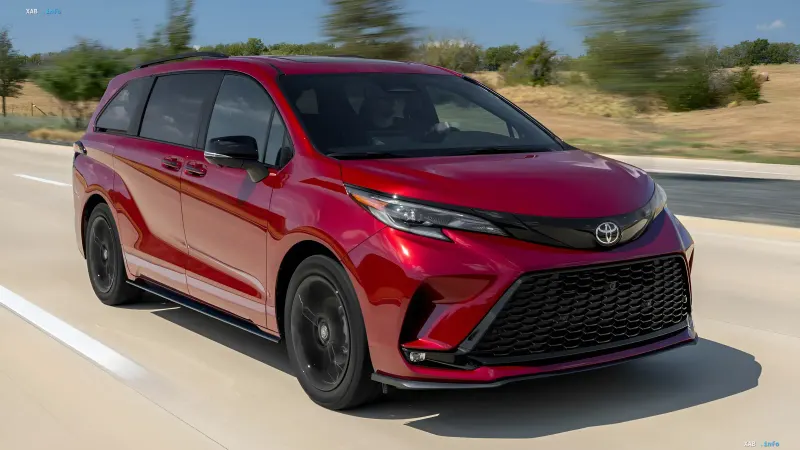
The official presentation of the updated 2027 Toyota Sienna took place on the US auto market. Externally, the minivan is practically indistinguishable from last year's version: Toyota has retained its recognizable silhouette, headlight shape, and overall body styling, making it hard to tell apart from the 2026 Sienna on the road. However, significant changes have occurred under the hood and in the electronics department. The central element of the facelift is the sixth-generation hybrid powertrain, which has completely replaced the previous one. It defines the new efficiency, dynamics, and comfort characteristics, which we will detail below.
Sixth-Generation Hybrid System: What's Inside
At the core of the new powertrain is a 2.5-liter gasoline engine paired with a 124 kW electric motor and a 1.15 kWh lithium-ion battery. Total system output has increased from 245 to 251 horsepower — a modest gain, but achieved through optimization rather than displacement increase. Toyota re-tuned the gasoline engine to operate at lower RPMs, reducing cabin noise in traffic, during parking, and at medium speeds. The electric motors have become more efficient, and the electronic architecture features a new control unit and updated software. The braking system deserves special mention: the 2027 Sienna adopts brakes from the 2026 Toyota RAV4, which should improve handling at high speeds and in emergency situations.
Steering and Dynamics
Toyota has also updated the steering system, introducing a new steering column, gear set, electric motor control unit, and torque sensor. The tuning makes the steering lighter at low speeds, which is especially important for maneuvering in parking structures and narrow city streets. In terms of dynamics, the front-wheel-drive version accelerates to 60 mph (96 km/h) in 7.5 seconds, while the all-wheel-drive version does it in 7.6 seconds. The latter features an additional 40 kW electric motor on the rear axle to provide four-wheel traction. Despite the power increase, the minivan has become more efficient: city fuel consumption for both versions dropped from 6.5 to 6.0 l/100 km, highway consumption from 6.7 to 6.4 l/100 km, and combined consumption stands at 6.4 l/100 km.
Interior and Equipment: Digital Instrument Cluster and New Options
All versions of the 2027 Sienna now feature a 12.9-inch digital instrument cluster and a 12.3-inch multimedia touchscreen running next-generation software. The cabin introduces a new steering wheel, ambient LED lighting, and a factory dashcam — features previously reserved for top trim levels or offered as accessories. The base LE trim now comes standard with a foot-activated hands-free liftgate sensor, while the top-tier XSE receives ventilated front seats, a head-up display, driver's seat memory, and other features. Thus, Toyota has redistributed previously optional equipment into base and mid-level trims.
Pricing and Release Date
Sales of the updated Toyota Sienna will kick off in early 2027, with official pricing to be announced closer to launch. For reference, the base LE trim of the 2026 Toyota Sienna in the US starts at $42,915 including destination. Analysts estimate the starting price of the updated model will approach $45,000. This represents an increase of roughly $2,000 to $2,500 compared to the current generation, justified by the hybrid system update, expanded standard equipment, and new electronic architecture. For buyers looking for a family minivan with a hybrid setup and fuel economy around 6 l/100 km, the 2027 Sienna remains one of the few factory-built offerings combining space, efficiency, and hybrid reliability without forcing buyers to pay extra for options.