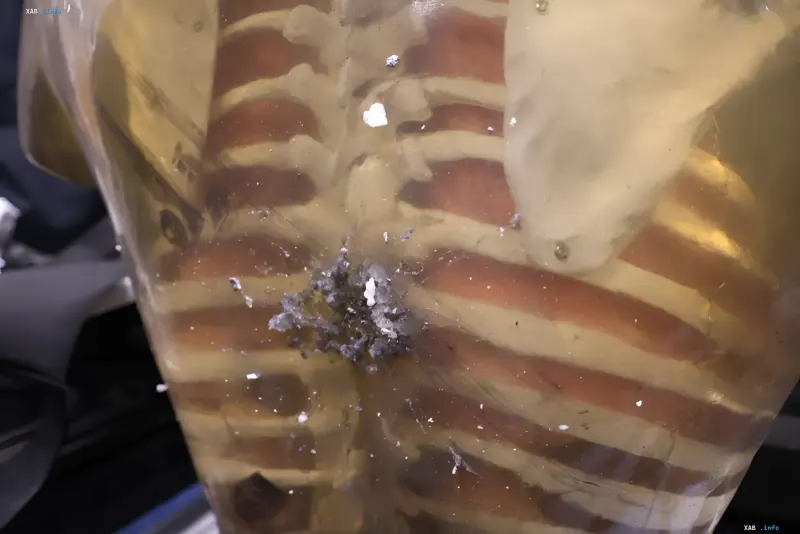
American company Atomic-6 has conducted a series of tests on the Space Armor Lite composite protective tile at the Texas A&M University Hypervelocity Impact Laboratory. The structure was originally developed to protect satellite systems from micrometeorites and orbital debris fragments. During the experiment, the tile was struck by a 3-millimeter aluminum sphere accelerated to 7.2 km/s—approximately 20 times the speed of sound. A ballistic dummy simulating human soft tissue and bone structure was positioned behind the protective element.
Results: No Penetration, No Secondary Shrapnel
According to data published after the test, the ballistic dummy showed no visible damage or penetration. The back side of the tile also retained its integrity: no bulging, cracking, or separated composite fragments were detected. This means that the impact energy was absorbed and dissipated within the protective element without generating a secondary stream of debris that under real conditions could injure a person or damage sensitive equipment.
Control Experiment: Solid Aluminum Fails
Under identical conditions—the same speed, the same projectile diameter, the same dummy—a solid 4-millimeter-thick aluminum plate was used instead of the composite tile. The result was the opposite: the plate failed to stop the impact, and material fragments penetrated inside the ballistic dummy. Comparing the two samples allows an assessment not only of the shield's ability to stop a flying object, but also of the risk of so-called secondary injury, where particles break off from the inner surface of the defense during a collision and continue moving toward the protected object.
Important Caveat: Not a Full Whipple Shield
At the same time, the control aluminum plate was not a full-fledged Whipple shield—the standard spacecraft defense structure consisting of several spaced layers that sequentially dissipate hypervelocity impact energy. Consequently, the conducted test does not prove Space Armor Lite's superiority over all existing astronaut protection systems. It demonstrates that under the given conditions, the composite tile performs no worse, and in terms of secondary injury performs better, than a monolithic metal barrier of the same thickness.
The Path to the Spacesuit: 14 kg/m² Density and Sealing Issues
Atomic-6 is considering the application of Space Armor Lite in spacesuits for extravehicular activity. The tile used in the experiment has a density of 14 kg/m² and is significantly thinner than traditional multi-layer Whipple shields, which require several centimeters of clearance to function. However, before practical integration into a spacesuit, the company must overcome a number of limitations. In the conducted test, the dummy was stationary, not inside a spacesuit, and lacked pressure or life support systems. The experiment did not answer key questions: what specific injuries a person would sustain from such a hit, and whether the spacesuit would maintain its hermetic seal.
Plans for Upcoming Tests
The company has announced a series of new checks: it plans to use curved tiles, varying impact angles, to bring the experimental conditions closer to human anatomy—the shape of the human chest or shoulder joint. The results of these tests will determine whether Space Armor Lite can transition from satellite protection to a component of astronauts' personal equipment.