At the RE+ 2026 international energy exhibition in Las Vegas, Chinese company Trina Storage introduced the Elementa Hybrid Genset hybrid energy platform, designed to supply electricity to large-scale data centers, primarily those serving artificial intelligence computing workloads. The installation combines gas generators and battery energy storage systems into a single system capable of creating fully autonomous or partially grid-independent power sources ranging from 5 megawatts to 1 gigawatt. The platform premiere comes against the backdrop of rapidly surging energy consumption by AI infrastructure, which has already become a key factor constraining the expansion of computing capacities worldwide.
The Problem Solved by Hybrid Architecture
Computing workloads in data centers running machine learning and generative AI models are characterized by sharp and unpredictable fluctuations. Consumption can briefly surge by multiples, causing load spikes that conventional gas generators cannot respond to instantly due to the inertia of mechanical and thermodynamic processes. Battery storage systems, by contrast, deliver energy almost instantly, but their capacity is not designed to supply a facility with electricity for extended periods. In the Elementa Hybrid Genset, these two types of sources work in tandem: batteries compensate for short-term load peaks while gas units gradually ramp up generation to the required level. This approach maintains stable power supply for critical systems without requiring excessive overcapacity in generators.
Platform Technical Configuration
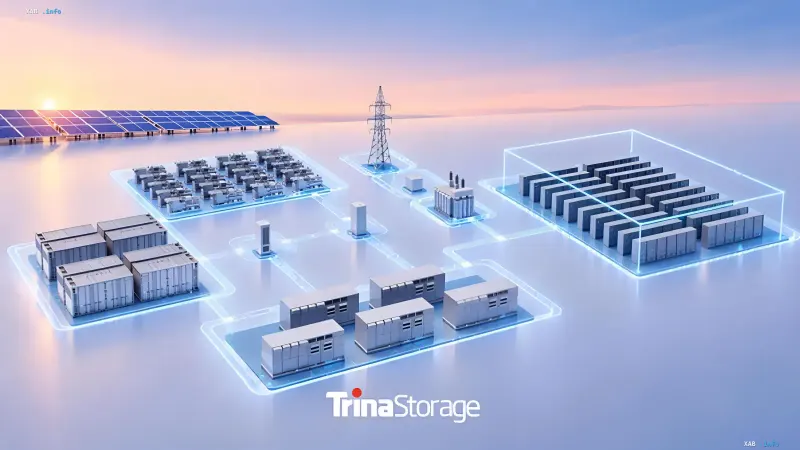
The Elementa Hybrid Genset platform includes three main components: gas generators with a capacity of up to 2.5 MW each, the Elementa DC battery system, and the Electra AC power conversion platform. A dedicated controller manages the entire system, forecasting load changes, distributing power among sources in real time, and isolating faulty equipment so that remaining components continue supplying electricity to critical systems. The platform architecture is modular and scalable: the configuration can be adapted to a specific facility and, if necessary, supplemented with solar panels to reduce the share of fossil fuel generation. A conceptual render published by Trina Storage shows the full chain — from solar arrays and a substation with high-voltage power lines to containerized battery units and generator sets united by a single management system.
Four Operational Scenarios
The Elementa Hybrid Genset is designed for four primary application scenarios. First, operating within a standard power grid with backup generators for emergency outages. Second, connecting facilities where existing grid transmission capacity is limited and cannot meet full consumption. Third, temporary power supply for data centers during construction, prior to completing main grid connection. Fourth, fully autonomous facility operation independent of the external power grid. Scenario flexibility makes the platform applicable to both greenfield projects and the modernization of existing capacities.
What Else is in Development and Limitations
Despite its demonstration at RE+ 2026, Trina Storage emphasizes that the system is still undergoing testing. Specifically, local microgrid formation capabilities, hybrid control strategies between sources, and equipment certification are still under development. Actual operational characteristics — efficiency, response time, battery circuit longevity — will depend on the specific project configuration and deployment conditions. The company has not disclosed commercial timelines for mass launch or pricing parameters.
The presentation of the Elementa Hybrid Genset occurs amid a global shortage of capacity for connecting new data centers to power grids: in several regions, connection queues span years, and AI workload power consumption is growing exponentially. Hybrid solutions combining the instant response of batteries with the continuous generation of gas generators are becoming one of the industry's primary answers to this challenge. Trina Storage, previously known primarily as a photovoltaic module manufacturer, is thus expanding its portfolio toward enterprise-grade systemic energy solutions.