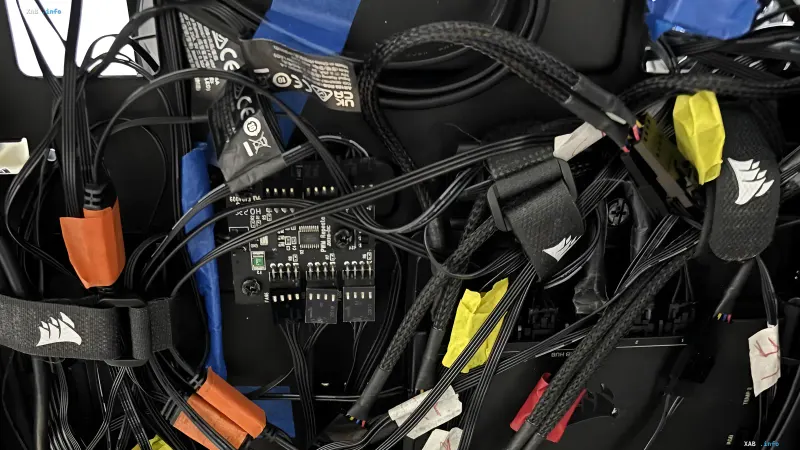
The owner of a Gigabyte GeForce RTX 5090 Aorus Xtreme Waterforce, unsatisfied with the stock liquid cooling system, decided to take cooling to the extreme by installing 30 fans in the case. They shared details of this unusual setup on Reddit, publishing photos of the internal system and benchmark results. While the fans themselves aren't visible in the images, the scale of the "cable chaos" is clearly demonstrated: bundles of wires, sleeves, and connectors, all carefully labeled by the author to avoid confusion.
How the System Works: Case, Mounts, and Control
The enthusiast chose the Corsair 7000D Airflow case, which, thanks to its size and mesh construction, allows for significant airflow. The fans are attached via magnetic mounts, and their fan speed is managed by a separate control system: each fan runs at its own custom speed, creating directed, supplemental airflow through the radiator of the video card's stock liquid system. This approach allows the radiator to be cooled more effectively than in a standard configuration, without interfering with the electrical parameters of the board itself.
Test Results: Temperatures and 3DMark Scores
According to the published data, in standard mode—without undervolting or overclocking—the RTX 5090 maintained an average temperature of 33°C in Steel Nomad, scoring 14,938 points at 149.38 FPS. In Time Spy Extreme, the result was 23,899 points with an average temperature of 35°C, and in standard Time Spy, the card hit 39,718 points with an average heat of 32°C. Thus, the system remained within the 32–35°C range throughout all tests, which is an remarkably low value for a flagship accelerator under full load.
Monitoring and Comparisons with Other Builds
Monitoring showed that the GDDR7 memory operated at a speed of 28 Gbps and reached a maximum of 49°C during extended loads, while the GPU clock reached 3052 MHz. Compared to other RTX 5090 owners whose results are collected in 3DMark tables, this non-standard cooling system provided a performance boost of nearly 7%. While not an absolute record, it is significant that the gain was achieved without changing stock power or voltage parameters—purely by utilizing thermal headroom.
The Price of Experimentation: Bulk and Noise
The main compromise of the project is the visual and acoustic "price" of the results. Thirty fans, magnetic mounts, and wire bundles make the build extremely bulky, and the operation of numerous fans at different speeds is unlikely to be quiet. This solution is clearly not for those who value a clean build or silence, but as an engineering experiment, it clearly shows how much thermal potential remains untapped in flagship video cards when combined with proper airflow.