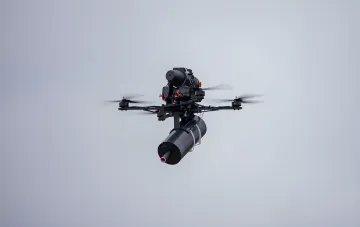
Ukrainian company 3DTech, specializing in the production of fiber-optic drones, has unveiled a drone swarm control system called Hydra. This was announced in an interview with RBC-Ukraine by the company's CEO, Oleksiy Zhulinsky, and R&D head Ilya Filimonov. The unveiling of the new system coincided with the discussion of one of the most pressing issues in the defense industry — the transition to procurement of weapons based on tactical-technical characteristics (TTC), which this summer became the main point of tension between the Ministry of Defense and military equipment manufacturers.
Transition to TTC-Based Procurement: From Blockage to Partial Unblocking
Under the terms of the European Union's reparations loan for military equipment, funds may be spent exclusively through tenders, and the TTCs for these tenders were to be prepared by specially created centers of competence — a joint structure of the Ministry of Defense and the General Staff. However, according to industry data, in the first six months of operation, these centers managed to prepare only four TTCs for four types of equipment. Manufacturers openly warned of the risk of supply disruptions by winter. The situation was partially unblocked in August: after a meeting between the Ministry of Defense and manufacturers, the ministry approved the overwhelming majority of the characteristics and transferred them to the Defense Procurement Agency. However, full synchronization between the General Staff and the Ministry of Defense was not achieved at this stage.
3DTech's Position: Competition Should Not Be Reduced to the Lowest Price
Oleksiy Zhulinsky stated that the principle of TTC-based procurement is the right one for the company: manufacturers should compete on price, characteristics, and quality, while the state should receive products that truly meet the needs of the Armed Forces. Updating tactical-technical characteristics is not a problem in itself — 3DTech continuously improves its drones based on frontline experience and adapts production to new tasks. However, the key question remains how compliance with the stated characteristics will be assessed. 'Competition should not be reduced solely to the lowest price, as the stability of characteristics in mass-produced products depends on the quality of components, manufacturing, and testing,' emphasized the CEO of 3DTech. He added that scaling production requires clear rules, sufficient preparation time, and an understanding of the order pipeline, especially when it comes to modifying an existing product to meet new requirements.
Winter Challenges: Energy, Financing, and Team Fatigue
Discussing the challenges ahead for winter, Zhulinsky highlighted the risk of several problems intensifying simultaneously. The first is energy and security: the enterprise must be prepared for power outages, additional heating costs, and more difficult working conditions, while the company's resilience depends not only on itself but also on the stability of suppliers and logistics. The second problem is financing at the transition between budget years: manufacturers need to understand in advance what orders are expected at the beginning of the next year, as production cannot stop for several months — salaries must be paid, facilities maintained, and components procured. 'Prolonged work under wartime conditions, which has been ongoing for 12 years, exhausts the team, and in winter additional domestic difficulties are added. Therefore, we are already prioritizing how to ensure the team can work stably under various scenarios of the situation,' Zhulinsky said. He separately highlighted the readiness of products for winter conditions, which, according to him, must be verified in advance, taking into account product requirements, testing, quality control, and feedback from the military.
Four Systemic Challenges for the Industry
Zhulinsky outlined four main challenges for the defense industry: security, personnel, order predictability, and dependence on imported components. Production security, according to him, begins with protecting people: shelters, energy resilience, and the ability to resume operations after an emergency require significant investments and systematic cooperation between business and the state. The second challenge is the personnel shortage: the industry is already feeling a lack of engineers, technologists, and production workers, both experienced and entry-level specialists. The third challenge is order predictability, which directly affects planning and investments in production capacity. The fourth is dependence on imported components, which creates additional risks to production continuity under sanctions pressure and logistical constraints.
Contradictory Data
There is no direct contradiction between the statements of the parties in the provided sources. However, a significant discrepancy is noted in the assessments of the TTC system's readiness: on one hand, the Ministry of Defense in August announced the approval of the 'overwhelming majority' of characteristics, while on the other hand, the industry had previously warned of the risk of supply disruptions, and 3DTech representatives emphasize that full synchronization between the General Staff and the ministry has not been achieved. This indicates that the formal approval of characteristics is not equivalent to their practical applicability in tender procedures, and the issue remains open for monitoring in the coming months.