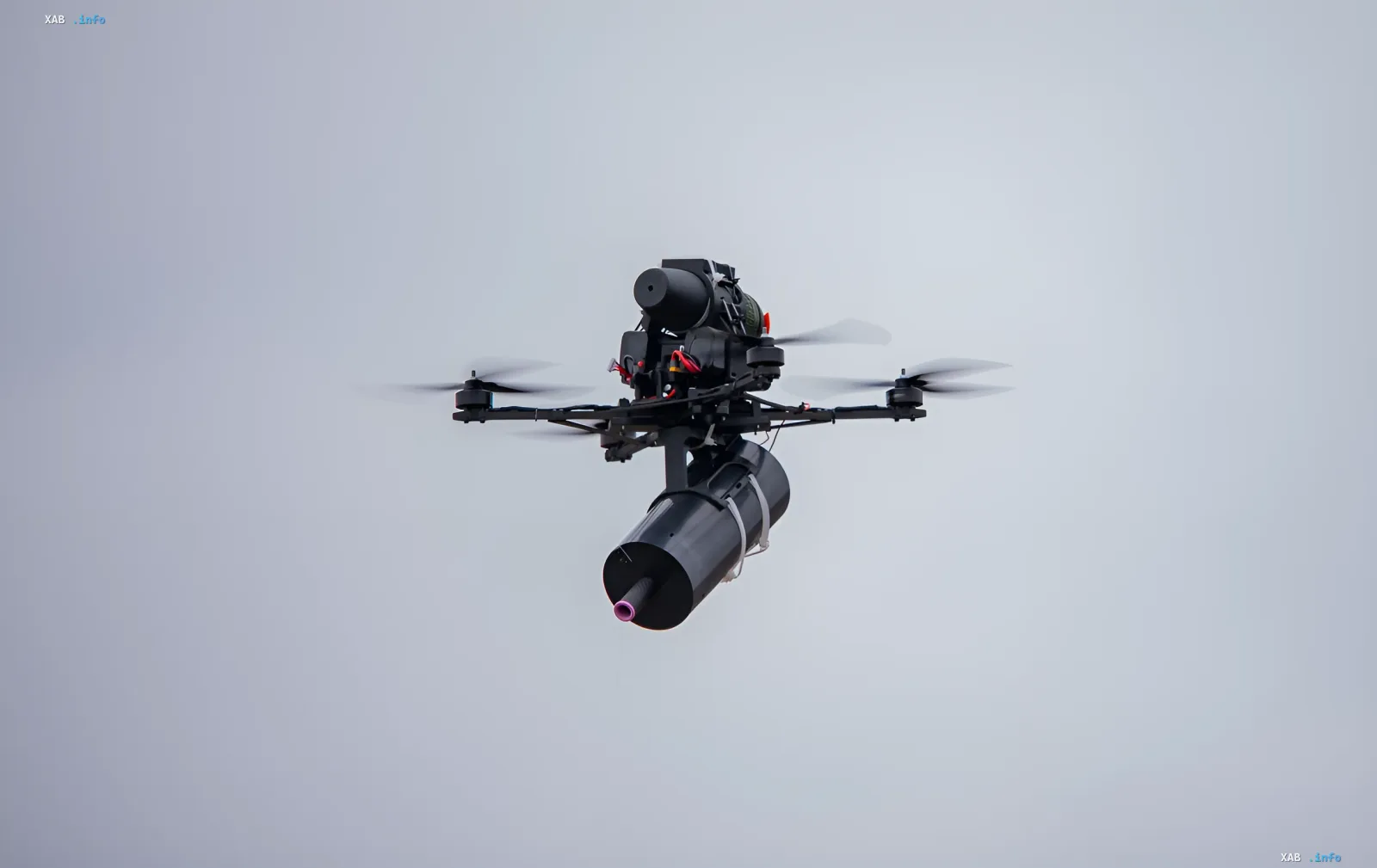
Ukrainian unmanned systems manufacturer «General Chereshnya» has announced it is preparing a report on a criminal offense to the National Anti-Corruption Bureau of Ukraine (NABU) in connection with a tender conducted by the Agency of Defense Procurement (ADP) for drones equipped with a fiber-optic communication channel. The company believes the procurement was organized illegally and opaquely, with its terms «tailored to specific manufacturers.» At the same time, anonymous sources in the defense sector, speaking on RBC-Ukraine, point to systemic corruption risks in the way the ADP carried out the competitive procurement of strike and strike-reconnaissance drones with a fiber-optic communication module.
NABU Complaint: What «General Chereshnya» Is Demanding
According to the company, its submission to NABU requests the registration of a criminal case and an investigation into the actions of officials of the State Enterprise ADP and the Ministry of Defense of Ukraine for signs of criminal offenses at the stages of announcing and conducting the tenders. «General Chereshnya» claims that a transparent procurement mechanism is absent and that the tender terms are formulated in such a way as to effectively exclude competitors. The manufacturer is demanding that the procurement be suspended or canceled until it is brought into compliance with the law, and that the procedure be moved to the open electronic platform Prozorro.
Procurement Outside Prozorro: How the Tender Was Conducted
An RBC-Ukraine source in the defense sector revealed details of the procedure: on August 20, the ADP sent a letter inviting manufacturers to submit commercial proposals for 52 lots of equipment, setting a submission deadline of August 26. The procurement was conducted outside the electronic system Prozorro — by emailing documentation to a limited circle of enterprises, without public announcement of the tender and without an electronic auction. The source emphasizes that this method is not provided for in the exhaustive list of defense procurement methods established by Cabinet of Ministers Resolution No. 1275, and it deprives participants of the right to challenge the terms and request clarifications, which is guaranteed by the Law «On Public Procurement.»
Signs of a «Rigged» Tender: Industry Assessment
An anonymous source points to a number of signs that, in his view, indicate the procurement terms were shaped for a specific manufacturer. In particular, some key technical specifications — maximum and operating flight altitude, cruise speed, takeoff weight — are not defined at all in the documentation, while other parameters are specified so narrowly that only a limited number of enterprises' products could meet them. The qualification criteria for tender participants, the source says, are not established. The industry also notes the absence of tenders for critically important items: ground robotic systems, FPV drones of various types, deep-strike weapons, and ammunition of all types and calibers for UAVs. «You can procure many drones, but without the ammunition to equip them with, it remains a waste of resources,» the source concludes.
Contradictory Data
The parties' positions on the substance of the accusations diverge significantly. «General Chereshnya» and anonymous industry sources claim that the tender terms were shaped for specific manufacturers and that a corrupt element is traceable in them. Yuri Hudymentko, head of the Public Anti-Corruption Council at the Ministry of Defense, told RBC-Ukraine that there is currently no direct evidence that any tenders were written for specific participants. At the same time, he acknowledges signs of instability in the procurement process itself. Thus, the fact that a NABU complaint is being prepared is confirmed by several sources, however, the qualification of the ADP's actions as corrupt remains a matter of dispute: for one side it is a «rigged» tender, for the other — a lack of direct evidence of intent.
Structural Problems and Positive Elements
Despite the criticism, the RBC-Ukraine source highlights one positive element of the procedure: the limitation of a single supplier's share to no more than 50% of a lot, intended to broaden the circle of participants. At the same time, the source notes that this limitation theoretically allows two large manufacturers to agree between themselves and effectively divide the market. The deeper problem, in the industry's assessment, is that all functions are concentrated in a single ministry — the formulation of tactical and technical specifications, requirements for production and manufacturers, procurement, grants, selection of promising technologies, and quality control. «This creates a classic situation: I buy from myself and I control myself,» the source formulates. At the same time, the transition to tender procedures, which is an EU requirement for receiving financing, is not in itself considered a problem: such procedures were applied in Ukraine before as well. The risk, in the source's view, is linked to the fact that a full transition to tenders will accelerate the formation of so-called «primes» — large reliable suppliers capable of guaranteeing price, quality, volumes, and quickly recovering after production losses. This, he says, is a logical global practice in which each market segment retains competition among five to six leading manufacturers. The main condition is that this competition remains a competition of quality, not a price cartel.
Context and Prospects
The scandal over the fiber-optic drone tender is unfolding against the backdrop of an ongoing debate on the reform of defense procurement in Ukraine. The industry emphasizes that the tenders remain closed: it is unknown who becomes the winner, what sums are stated in the contracts, and what the average procurement price is. In conditions where transparency is a key condition of trust on the part of both domestic manufacturers and international donors, the preparation of a NABU complaint by an active manufacturer could become a precedent for reviewing the methodology of conducting defense procurement. The results of the NABU investigation and the ADP's position on the substance of «General Chereshnya's» claims will be decisive for the further dynamics in the industry.