Record Order: 280 Aircraft by 2029
Taiwan's naval forces will receive 280 American vertical takeoff and landing (VTOL) drones, the V-BAT (also known by the designation MQ-35A), manufactured by Shield AI, by the end of 2029. This is reported by RBC-Ukraine, citing data from Army Recognition. As the outlet notes, this is the largest batch of this type of aircraft that Taiwan is bringing into service as part of its preparations for a possible conflict in the Taiwan Strait. At the time of writing this article, September 2026, the first batch is already in the delivery phase: according to the plan, the current year, 2026, accounts for 40 drones, i.e. about 14.3% of the total order volume.
Delivery Schedule and Ancillary Equipment
Deliveries are spread over four years and show a pronounced upward trend: 40 aircraft (14.3%) in 2026, 110 (39.3%) in 2027, 64 (22.9%) in 2028, and 66 (23.6%) in 2029. Thus, by the end of 2027, Taiwan will have 150 machines in service — more than half, 53.6%, of the entire order, with the remaining 130 units arriving in 2028–2029. Along with the drones, the island will receive 140 control systems and 82 vehicles: the ratio is two drones per control station and roughly 3.4 aircraft per vehicle. In parallel, Taiwan is funding a separate program — the purchase of 32 Albatross II reconnaissance UAVs produced by NCSIST for 16.78 billion New Taiwan dollars.
V-BAT Technical Profile and the Block 5.3 Update
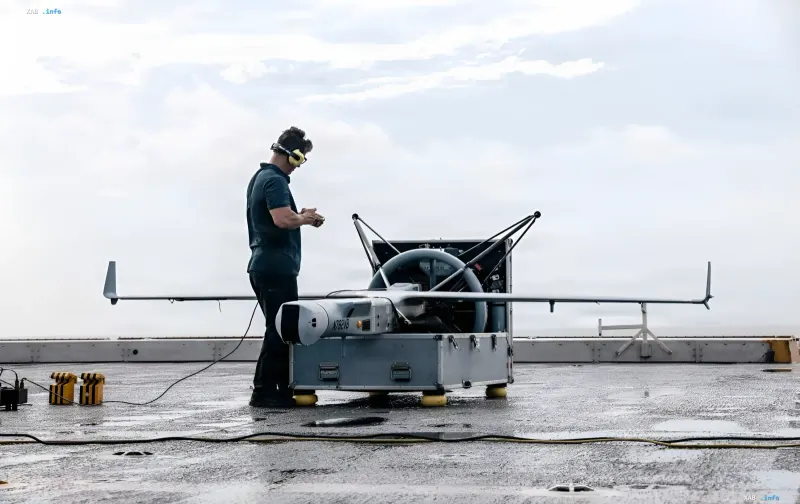
The V-BAT is a 75-kg tail-sitter drone with a wingspan of 3.8 m and a height of 2.9 m, a top speed of 90 km/h, and a service ceiling of 5,486 m. Key for naval use was the Block 5.3 configuration update, unveiled in April 2025: the gasoline engine was replaced with a 33-hp unit running on heavy fuel, compatible with aviation JP-5, which is standard aboard warships, simplifying maintenance at sea. The same update raised the maximum payload from 11.3 to 18.1 kg (an increase of 6.8 kg, or 60%), and enlarged fuel tanks allowed the endurance with an electro-optical payload to reach 12 hours. With satellite communications and a 9.1-kg load, the stated one-way range reaches 648 nautical miles (about 1,200 km); for close-in control, relay radio links provide line-of-sight up to 139 km, phased-array antennas up to 180 km, and the satellite channel allows controlling the aircraft beyond line of sight. At least two operators can deploy and prepare the drone for flight in under 30 minutes, and vertical landing requires a pad of roughly 4.6 by 4.6–4.7 m, allowing the aircraft to be operated from a ship's deck or a coastal area without a runway. Among the payload options are EO/IR turrets, a synthetic-aperture radar, an AIS system, ViDAR, satellite communications, and GNSS anti-jamming protection, with the drone capable of supplying up to 600 W of power to the payload.
Ukraine's Combat Experience as a Test Range
A concrete example of V-BAT use under active suppression of satellite navigation and communications came from Ukraine, where the drone began combat trials in June 2024 against Russian forces, which made extensive use of GPS jamming and electronic suppression of communications. In an August 2024 experiment, the V-BAT located the positions of Russian air-defense systems and transmitted target information that was subsequently used for HIMARS strikes. In one mission, the aircraft operated at a distance of about 100 km along the front-line electronic-warfare belt, searching for a mobile Buk-M1 air-defense system — that is, it was pushed beyond the main EW belt to find a moving target, rather than being used as a close reconnaissance asset over friendly positions.
Strategic Significance for the Taiwanese Navy
The Taiwanese navy plans to assign V-BATs to surface combat groups and coastal defense units so that they can have their own means of reconnaissance and target designation, without relying entirely on shore-based radars, airfields, or large manned aircraft. What matters is not only the number of drones but also the volume of ancillary equipment purchased, which allows the aircraft to be dispersed as mobile units across the fleet and the coastline, rather than being operated from a single centralized base. It is precisely this decentralized model, complemented by the Ukrainian experience of operating under EW conditions that has been proven in real combat, that makes the order a strategically important element of the island's defense.