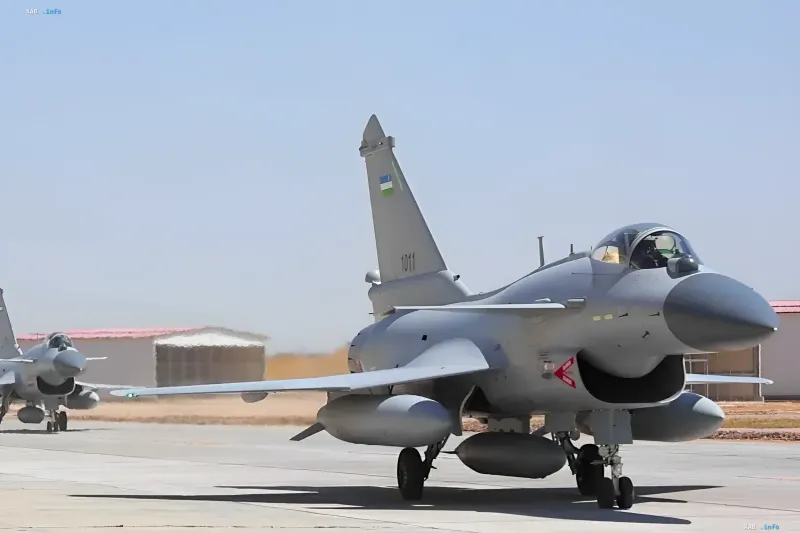
Military-technical cooperation between Uzbekistan and China has reached a fundamentally new historical milestone, dramatically altering the security architecture across Central Asia. During a press conference, Senior Colonel Jiang Bin, an official spokesperson for China's Ministry of Defense, stated that defense relations between the two nations are deeply collaborative and friendly. He officially emphasized that the military-trade partnership between Beijing and Tashkent fully complies with international law and is not directed against any third parties. This statement officially confirmed that following Pakistan, Uzbekistan has become the world's second foreign buyer and operator of advanced Chinese J-10CE multi-role fighter jets.
Technical Capabilities and Delivery of Modern Fighters
Developed by the Chengdu Aircraft Corporation, these 4.5-generation multi-role combat aircraft are capable of achieving air superiority and executing high-precision strikes against strategic ground and maritime targets. The actual delivery of the jets took place in late August 2026, when at least six J-10CE aircraft bearing national Air Force insignia were publicly showcased at the Karshi-Khanabad airbase. Although the total number of purchased aircraft remains classified, independent defense analysts estimate the base cost of each fighter to be between 40 and 50 million US dollars, excluding expenses for weaponry and pilot training.
Contradictory Data
Despite official confirmation of the deliveries and the public demonstration at the airfield, certain discrepancies regarding the total contract volume persist within expert circles and media reports. While official sources and initial reports indicate the arrival of at least six aircraft in the first batch, some foreign analytical outlets and regional publications, such as Minval.az, cite closed sources claiming that the total procurement volume could reach up to 24 combat aircraft. Such numerical differences are attributed to the classified nature of large-scale military-trade deals and phased delivery schedules that may be adjusted based on the manufacturing capabilities of China's defense industry.
Geopolitical Significance and Strengthening Defense Capabilities
The rearmament of the Uzbek armed forces with advanced Chinese aviation marks a transition toward a multi-vector defense policy, reducing technological dependency on a single traditional supplier. The integration of 4.5-generation fighters equipped with active electronically scanned array (AESA) radars and long-range missile systems significantly surpasses the capabilities of older Soviet-era aircraft like the MiG-29 and Su-27. Stationing the squadron at the strategically vital southern Karshi-Khanabad airbase guarantees the reliable protection of the republic's airspace and demonstrates Tashkent's determination to independently and effectively ensure regional stability.