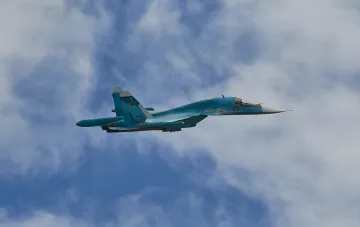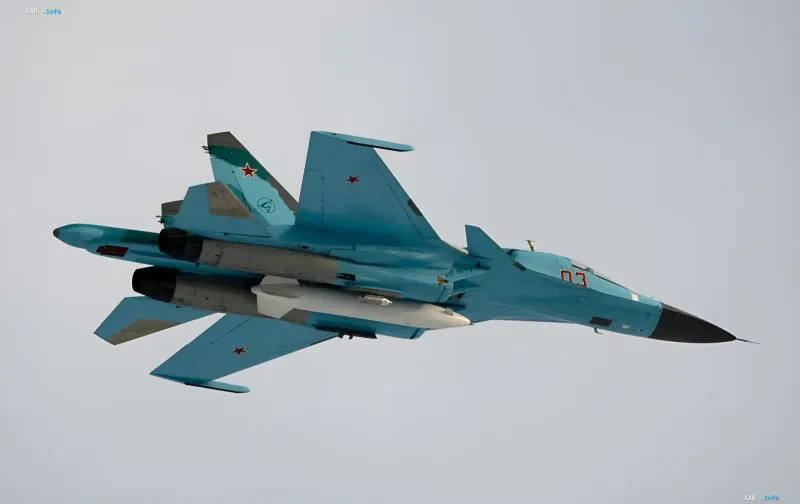
Over the past weeks, Ukraine's Defense Forces have disabled eight Su-34M frontline bombers, and according to aviation expert Anatoliy Khrapchynskyi, it will take Russia approximately two years of work by the Chkalov Novosibirsk Aviation Plant to restore this fleet. RBC-Ukraine reports this citing the expert's statement. According to him, the eight disabled aircraft represent two-thirds of a full operational squadron of the Russian Aerospace Forces, and their total cost, together with ground equipment, is estimated at approximately $400 million.
Strikes on Open Parking Lots
According to the Navy of the Armed Forces of Ukraine, on the night of October 15, they struck a Russian airfield in the Voronezh region, where six Su-34M bombers were reportedly destroyed. Subsequently, the Navy reported another result: two Su-34s at the Marinovka airfield in the Volgograd region were hit by the Neptune coastal missile system. The statement notes that the aircraft were located at the territory of the 11th Mixed Aviation Regiment of the 4th Mixed Aviation Division of the 4th Air Force and Air Defense Army. The Ukrainian military emphasized that Russia uses Su-34s to strike Ukrainian cities and Defense Forces positions with guided aerial bombs.
Scale of Losses According to Expert Assessment
Anatoliy Khrapchynskyi clarifies that this involves six hit Su-34Ms in Borisoglebsk and two more aircraft in the recent Navy report. In total, the eight disabled frontline bombers, according to his calculations, make up two-thirds of a full squadron. The expert estimates the cost of these vehicles along with ground equipment at about $400 million and notes that the two Navy operations have effectively wiped out almost two years' worth of work by the manufacturing plant.
Two Years of Plant Operation at Maximum Capacity
According to Khrapchynskyi, building eight new Su-34Ms from scratch for the Chkalov Novosibirsk Aviation Plant means almost two years of operation of the entire enterprise at the limit of its capabilities. The expert emphasizes that the plant operates under sanctions and a shortage of Western microelectronics, which additionally limits production rates. This is precisely why, according to him, the losses inflicted in a matter of weeks are comparable to a multi-month, or rather two-year, production cycle.
The Russian Command's Dilemma
Khrapchynskyi believes that the Russian command is facing a difficult choice. Leaving the aircraft about 300 km from the border means the risk of new strikes on open parking lots. Moving them 500–600 km deep into the country means burning the engine resource of AL-31F engines on transit flights, losing sortie intensity, and giving Ukrainian intelligence and air defense more time to counter them. Thus, either strategy carries tangible operational costs for the Russian Aerospace Forces.
Total Su-34 Fleet in the Russian Aerospace Forces
According to the Main Directorate of Intelligence (HUR), as of October 22, 2026, the Russian Aerospace Forces have about 140 Su-34s of various modifications in service, including the Su-34M. Since the beginning of the full-scale invasion, according to the same data, Russia has lost 43 aircraft of this type destroyed, with another seven damaged. The destruction of eight machines in recent weeks thus makes a noticeable contribution to the total losses of the fleet, which, according to the expert, will take years to recover.