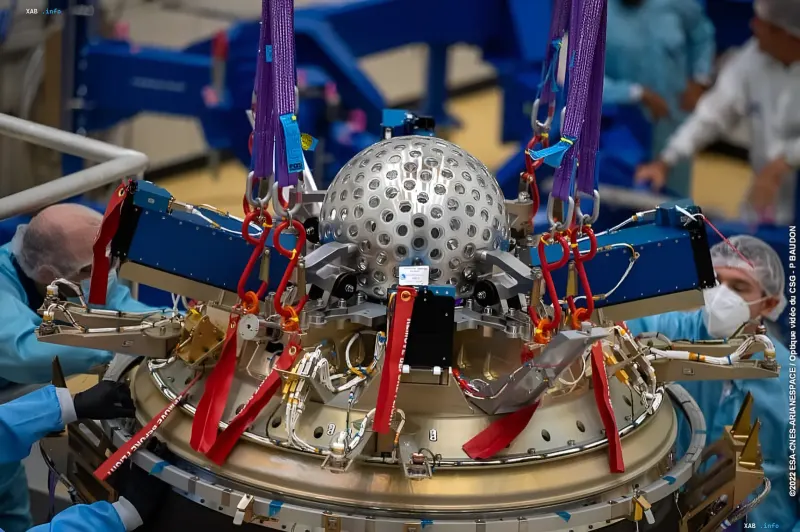
Modern physics has received powerful reinforcement: Chinese researchers from the Wuhan Institute of Physics and Mathematics have published results in the journal Nature that represent the most precise practical confirmation of Albert Einstein's general theory of relativity. Scientists managed to record how the Earth's mass "curves" spacetime, achieving unprecedented measurement accuracy.
The Lense-Thirring Effect and Record Accuracy
At the heart of the research lies the so-called "frame-dragging effect" or the Lense-Thirring effect. This phenomenon, modeled back in 1918, states that a massive rotating object distorts the surrounding space. The heavier the object and the faster its rotation, the stronger this distortion.
The main breakthrough was the reduction of measurement error. While uncertainty in previous attempts reached 10 percent, in the new experiment it amounted to just 0.2 percent. This achievement not only confirms Einstein's theory but also allows for strict limitations on alternative gravity models attempting to unify it with quantum mechanics.
Technical Implementation of the Experiment
A specialized satellite was used to conduct the measurements. Its design features high density and weight, allowing for the minimization of the influence of non-gravitational forces in a medium orbit. The entire surface of the spacecraft is covered with 303 corner reflectors.
The experiment lasted from July 2022 to June 2025. During this period, ground stations irradiated the satellite with laser beams and recorded the reflected signals. As a result, a database containing 200,000 observations with an accuracy of up to 1 millimeter was formed.
Fighting Interference and Final Data
One of the main difficulties was ocean and land tides caused by the gravitational influence of the Moon and the Sun. Scientists managed to solve this problem by using the time factor: the influence of tides is mutually compensated in a precession cycle lasting 1050 days. Data cleaning from interference was carried out using GEODYN software developed by NASA's Goddard Space Flight Center.
As a result of processing, physicists recorded that the satellite orbit shifts by 61.3 arcseconds per year due to the Earth's rotation. The obtained value perfectly matched Einstein's theoretical predictions. The authors emphasize that this result sets strict limits for alternative theories, such as Chern-Simons gravity.