Scientists from the University of Oulu have made a discovery that forces a reevaluation of insect intelligence. An international team of researchers found that bumblebees are capable of independently solving complex logical tasks using tools, without any prior training. The results of the study, published in the prestigious journal Science, demonstrate cognitive abilities previously thought to be the prerogative of large vertebrate animals.
A Chimpanzee Task in the World of Insects
The experiment was based on the classic "box and banana" problem, which psychologist Walter Köhler used as early as the beginning of the 20th century to study chimpanzee intelligence. In the original version, the monkey had to figure out that to reach a suspended banana, it needed to roll a box under it and climb up.
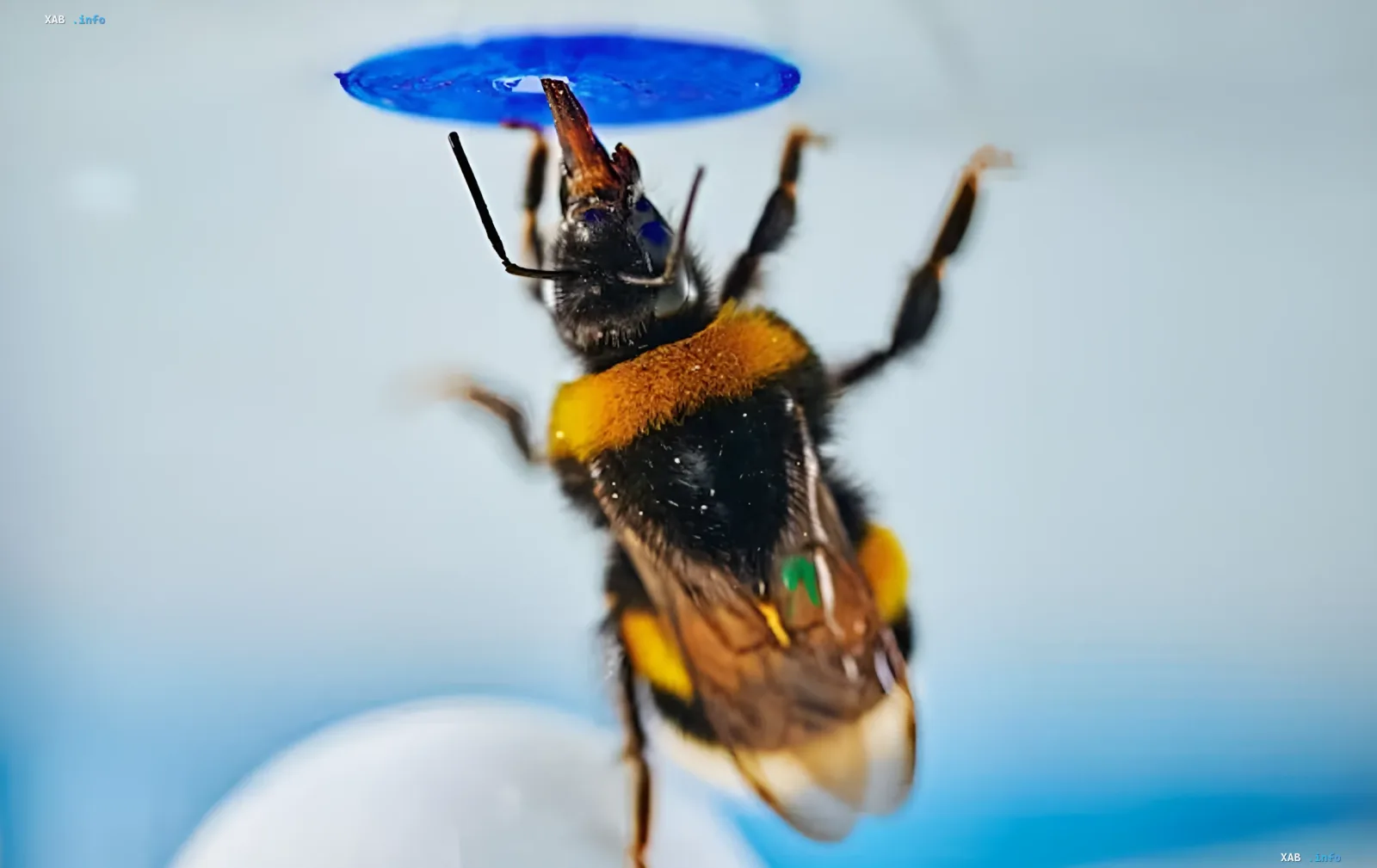
Researchers adapted this scenario for bumblebees. Instead of a banana, the insects were offered a sugary treat, and the role of the "box" was played by a small ball. The experiments were conducted in special enclosures where the bumblebees could not fly, ruling out the possibility of simply flying up to the goal.
Independent Problem Solving
First, the insects were taught a simple association: a blue circle on the floor meant the presence of a sweet reward. Then, the scientists complicated the task: the "flower" (blue circle) was moved to the ceiling, making it unreachable, while a small ball was placed on the floor.
Most of the bumblebees demonstrated remarkable ingenuity. They independently figured out that they needed to roll the ball under the blue circle and climb onto it to get the reward. Physicist Juhki-Heikki Kantola, one of the authors of the study, noted that the most astonishing fact was the lack of training for this specific action.
"There is a certain determination in their actions. It simply leaves the impression that something is happening in the brains of these creatures," Kantola commented on the results.
Memory vs. Randomness
To ensure that the bumblebees were acting consciously and not just moving objects chaotically, the scientists conducted a second phase of the experiment. The insects were placed in a space with two chambers, where one contained a blue circle. Then, the circle was made invisible using red light, but the ball was left behind.
The results confirmed the presence of spatial memory in insects: 23 out of 30 bumblebees correctly remembered the location of the target and moved the ball precisely to where the circle had previously been. This indicates that they used memory and orientation rather than acting at random.
Significance for Science and Nature
Biologist Amanda Litzner, who was not involved in the study, noted that the obtained data fully correspond to the behavior of bumblebees in the wild. When searching for nectar, they constantly learn to distinguish flowers, remember routes, and find their way back to the nest.
"Bumblebees possess an incredible ability to learn and remember," Litzner emphasized. She expressed hope that new discoveries would help society better understand the value of wild pollinators. In particular, the scientist called for a review of the use of pesticides, which can negatively affect insect memory and their ability to find food.
Boundaries of Intelligence
Despite the sensational nature of the results, the authors of the study call for caution in drawing conclusions. It is too early to speak of the presence of consciousness in bumblebees in the human understanding. However, the research indisputably proves that certain cognitive functions, which for decades were considered unique to humans and large mammals, may also be characteristic of representatives of the insect world.