There are mushrooms you can easily walk right past if you don't know where to look. And then there are the ones whose very presence the forest announces on its own — even before you see them. The common stinkhorn (Phallus impudicus) belongs to the latter group: its mature fruiting body emits a sharp smell that most people describe as the stench of rotten meat or sewage. It is precisely this odor that makes the mushroom practically impossible to miss — if you catch it in the forest, then somewhere nearby a ripe stinkhorn is already maturing.
From the white "egg" to the mature cap: how the mushroom grows in hours
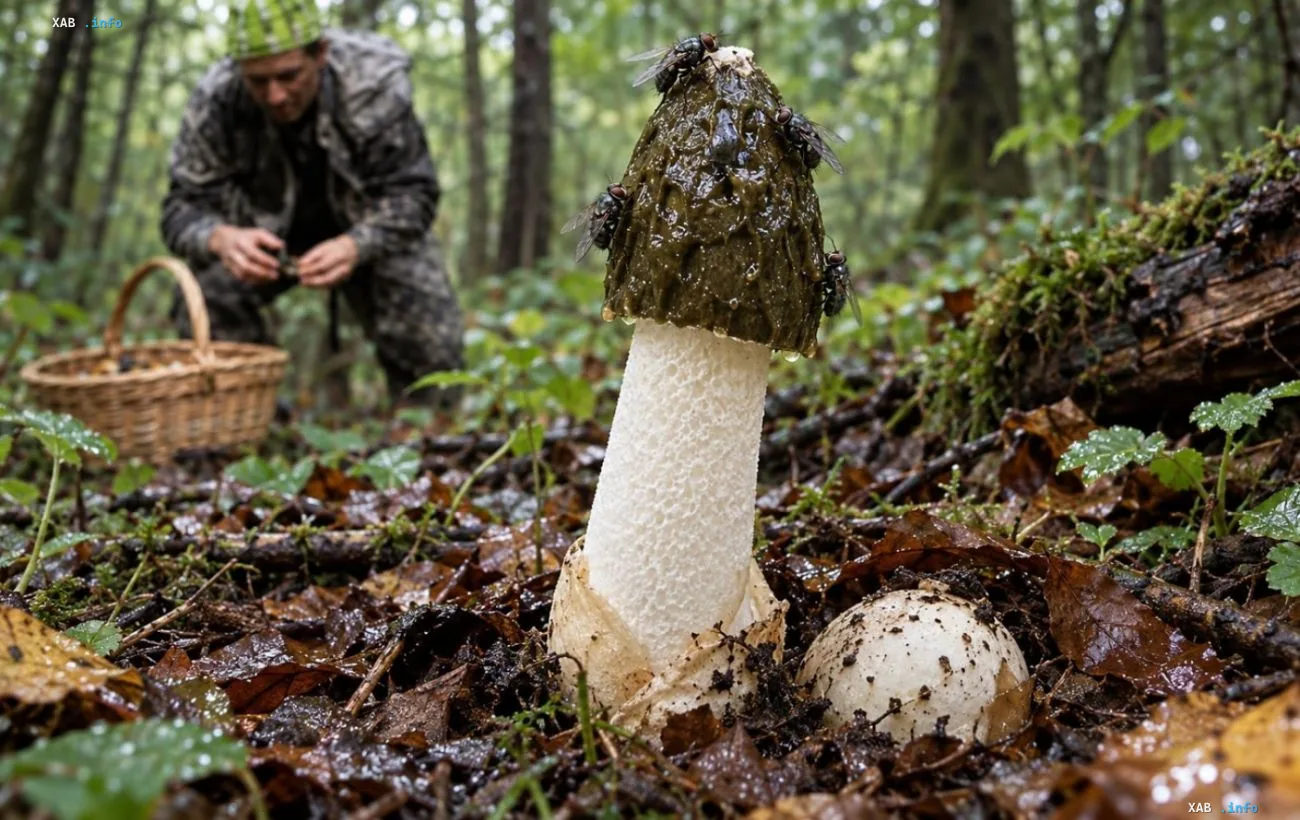
The common stinkhorn begins its development as a white, egg-shaped formation hidden in the soil or leaf litter. Inside, the future fruiting body is already essentially formed. As the mushroom matures, a white spongy stipe shoots out of the "egg" very quickly. A mature stinkhorn can reach 20–30 centimeters in height. At the top sits a conical cap covered with a dark greenish-brown slimy mass — the gleba — which contains the spores. According to the Oxford University Plants 400 reference, the fruiting body can elongate by roughly 1–15 centimeters per hour under sufficient humidity. That is why a mushroom that only recently looked like an ordinary white "egg" can suddenly be seen fully formed — literally within a few hours.
Foul odor as a reproduction strategy
Experts, citing data from Oxford University Plants 400, explain that the unpleasant smell of the stinkhorn has a perfectly practical purpose. The mature top of the mushroom is covered with a dark slimy mass — the gleba — containing spores. Its odor, reminiscent of decaying organic matter, attracts flies and other insects. The publication First Nature adds that insects land on the slime, pick up its particles on their legs, and carry the spores over considerable distances. Once most of the slime has been eaten, the characteristic foul-smelling top gradually recedes, revealing the reticulate surface of the cap. In other words, the smell of rotten meat is no accident for the stinkhorn — it is a kind of natural "bait." What seems repulsive to a human helps the mushroom attract insects and effectively disperse its spores.
Where to find the common stinkhorn in Ukraine
<According to the "Svit Grybiv Ukrainy" (World of Ukrainian Mushrooms) project, the common stinkhorn is fairly widespread in our country. It can be found in deciduous forests, gardens, and among shrubs — especially on organic-rich soils. This mushroom favors spots with abundant organic remains. In the wild it is found among fallen and decaying leaves, wood, or conifer needles. The National Nature Park "Skolivski Beskydy" describes similar growing conditions, for instance. If on a forest walk you suddenly catch a sharp smell resembling carrion, it is worth looking more closely at the ground: the stinkhorn often hides among the leaf litter, and its characteristic odor appears precisely when the mushroom matures.
Can the common stinkhorn be picked and eaten
It is important to emphasize: you should not determine the edibility of a wild mushroom based solely on its appearance or a description in an article. The common stinkhorn is mentioned in some sources as a conditionally edible species at the white "egg" stage, however, its safe use by a non-professional is extremely difficult. If a species is unknown to you, it is safer not to pick it. Any wild-growing mushroom, especially one with unusual morphology and a sharp odor, requires confident identification by a professional mycologist before any use.