Ukraine's forests hide inhabitants that could easily pass for horror movie sets. Among fallen leaves and decaying wood grow mushrooms resembling human ears, crimson tentacles, or blackened fingers protruding from a tree stump. Styler publication has gathered five unusual species with striking appearances and figured out which ones are safe to eat and which are best left untouched.
The Wood Ear: Auricularia
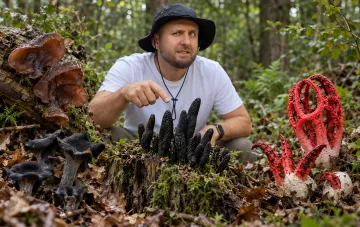
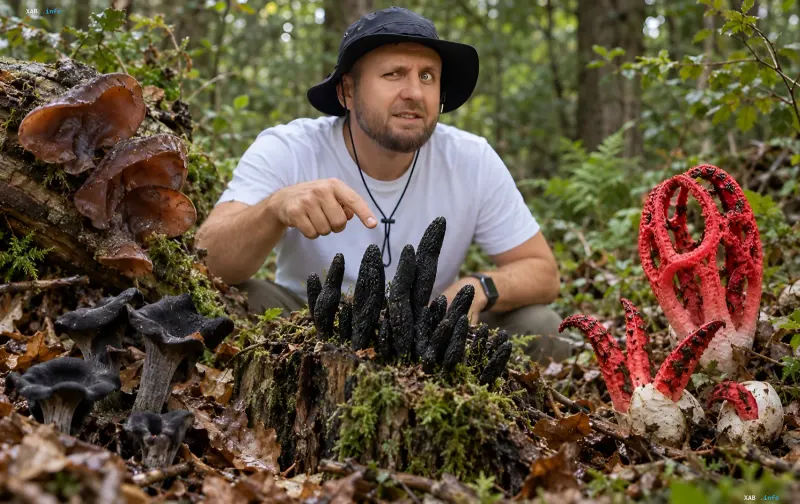
The "cutest" on this list is Auricularia. As blogger Yaroslav Fishchenko explains in a video published on the "Kharakternyk Show" Facebook page, the mushroom features a brown, jelly-like fruit body with wavy edges that genuinely resembles a human ear. It most commonly grows on dead elder wood, though it is sometimes found on other deciduous trees. According to the First Nature mushroom guide, Auricularia is edible after cooking: in East Asian cuisines, related species are prized for their characteristic crunchy texture in soups and other dishes. You should only forage it for consumption if you have accurately identified the species.
The Trumpet of Death: Black Chanterelle
The black chanterelle, or Craterellus cornucopioides, takes the shape of a deep funnel tapering downwards. Its color ranges from grayish-brown to nearly black, making it easy to miss against fallen leaves. At the same time, it is prized in culinary arts: according to a scientific review published in the journal Nutrients, the black chanterelle is classified as an edible species, used in sauces, dried, and added to dishes. In English, it is called the Trumpet of Death, but this name stems from its eerie appearance rather than deadly toxicity.
Red Tentacles: Lattice Stinkhorns
The lattice stinkhorn (Clathrus ruber) resembles a red cage or an extraterrestrial creature from afar. It first develops inside a white, egg-like sac before a crimson, hollow, lattice-shaped fruit body emerges. Inside the mature mushroom lies a dark, slimy mass with a pungent odor of rotting meat that attracts flies and other insects to disperse its spores. Experts note that the edibility of this species has not been properly confirmed, so the lattice stinkhorn should not be considered safe for consumption. A similar species, Clathrus archeri, also starts as a white egg from which crimson, finger-like or tentacle-like arms spread out; it is likewise not recommended for consumption since its toxicity is unconfirmed and safety is not established.
Dead Man's Fingers: Xylaria
Xylaria polymorpha grows on tree stumps, at the base of dead trees, and on rotting wood. Young fruit bodies can be light or whitish, but they darken with age to become nearly black, while their uneven, wrinkled surface resembles charred fingers — hence the eerie common name. According to the Missouri Department of Conservation and the British organization Woodland Trust, this species is not recommended for consumption: the fruit body is tough, woody, and unsuitable for standard cooking. In nature, the mushroom plays an important function by helping to break down dead wood and return nutrients to the ecosystem.
Are they safe to eat: What experts say
An unusual appearance does not automatically mean a mushroom is poisonous, but the lack of obvious danger signs does not guarantee it is safe to eat. Poison Control specialists remind us that wild mushrooms should never be consumed unless their species has been identified by a competent expert. Therefore, even the most "edible-looking" mushroom from the forest should only be foraged if you are certain of its species identification.