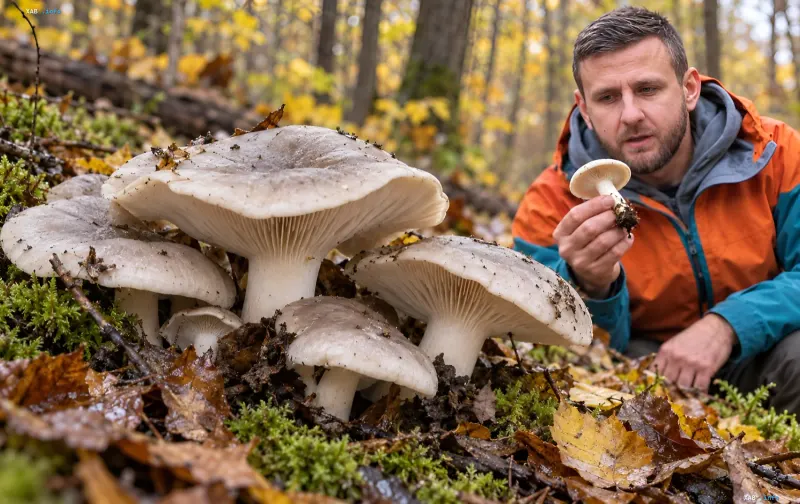
An autumn forest covered with a carpet of fallen leaves is a time when large grayish mushrooms with sturdy stems and a distinct aroma emerge in groups among the plant debris on the forest floor. We are talking about the clouded funnel mushroom (Clitocybe nebularis), also known in various guidebooks as the clouded agaric. This species has long been known to mushroom foragers: it is valued for its fleshy pulp and characteristic flavor. However, the clouded funnel mushroom has recently become one of the most debated fungi, with safety disputes surrounding it showing no signs of abating.
Tradition Versus New Data
In Ukrainian mushroom guidebooks, this species is traditionally described as conditionally edible: before preparation, it is boiled, the water is drained, and then it is fried, stewed, or pickled. This approach has become entrenched in culinary practice and passed down from generation to generation. However, the assessment of edibility depends not only on taste qualities and traditions, but also on the body's tolerance of the product and potential long-term risks, as pointed out by blogger Yaroslav Fishchenko in a video on his Facebook page "Kharakternyk Show". A turning point was the decision by the Swiss association of official mushroom control authorities, VAPKO, which in 2023 changed the status of the clouded funnel mushroom to inedible. The organization explained the revision by the presence of nebularin, a biologically active compound whose potential long-term effects still raise questions, according to their data. European guidebooks additionally note that the mushroom can cause gastrointestinal disorders even after proper heat treatment.
What Is Known About Nebularin
Scientific interest in the clouded funnel mushroom is not limited to its food properties. In a research paper published in the journal Mycobiology, researchers isolated several compounds from the fruit bodies of Clitocybe nebularis, including nebularin and phenylacetic acid. Under laboratory conditions, nebularin demonstrated moderate antifungal activity against certain fungal species. At the time, it is important to distinguish between two different issues: the detection of a substance's biological activity does not automatically mean it causes human poisoning, nor is it proof of its safety for food consumption. Swiss VAPKO emphasizes another aspect: nebularin is a heat-resistant compound, and its potential carcinogenic or mutagenic effects have not yet been reliably ruled out. This does not mean such consequences are confirmed, but this very uncertainty became one of the reasons for revising the mushroom's status.
Does Traditional Boiling Help?
A common practice among mushroom pickers is to pre-boil the mushrooms, drain the water, and only then cook them. According to VAPKO, this procedure does not remove nebularin. Boiling and draining the water may help get rid of some substances that irritate the digestive tract, but it does not make the mushroom guaranteed safe. Consequently, the claim that prolonged boiling completely neutralizes all dangerous components of the clouded funnel mushroom contradicts the recommendations of Swiss specialists. The most cautious position offered by experts is not to consume this mushroom, even if it has been repeatedly prepared according to traditional recipes in the past without noticeable consequences.
Where to Look and How to Identify It
According to the Ukrainian guidebook "World of Mushrooms of Ukraine", the species is found in various regions of the country: Right-Bank Polissya, Right-Bank and Left-Bank Forest-Steppe, and the Carpathians. The clouded funnel mushroom grows in deciduous, coniferous, and mixed forests; its fruit bodies appear on the forest floor among fallen leaves and plant debris, often in groups, sometimes forming characteristic arcs or so-called witch's rings. The species attracts attention with its grayish or gray-brown caps, which can be quite large, light cream gills, a sturdy stem, and a specific odor. At the same time, external features cannot be used as the sole basis for determining edibility: similar species may have completely different properties, and an identification error creates additional danger.
Conclusion for the Forager
The clouded funnel mushroom remains a fungus where specialist positions and traditional practice diverge. For those accustomed to gathering and cooking this species according to Ukrainian recipes, it is important to consider that European control bodies have revised its status and point to a heat-resistant compound that is not eliminated by boiling. A rational approach is not to rely solely on taste habits, carefully identify findings, and take into account current safety recommendations from specialists.