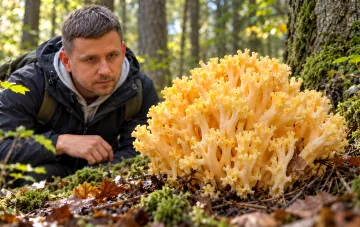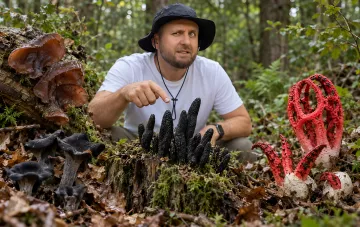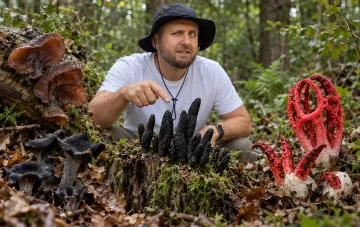
The first night frosts are traditionally seen as the end of the mushrooming season, but for some species, this is merely part of their life cycle. One of the most resilient representatives of the cold season is the winter mushroom, or velvet shank (Flamulina velutipes). Unlike typical autumn mushrooms, it is capable of growing from late autumn all the way through spring, withstanding sub-zero temperatures and resuming development during thaws. It is this unique trait that makes it a noticeable and fascinating find for those who continue to visit the forest after the first frosts.
Where to Look and How to Recognize the Velvet Shank
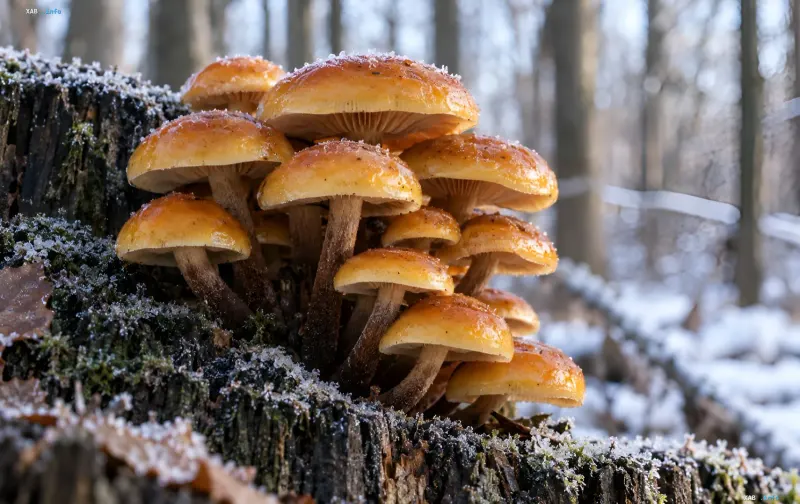
You should look for Flammulina not among fallen leaves, but on hardwood: on stumps, fallen trunks, and damaged areas of trees. The mushroom often forms dense clusters that stand out clearly against the dark background of the bark. The cap is usually yellowish-orange or reddish-brown, and in wet weather, it becomes slippery and shiny. The stem darkens toward the base and has a characteristic velvety surface. An additional factor favoring autumn-winter foraging is that when the foliage drops, the bright caps on dark wood are visible from afar, and the absence of dense vegetation reveals areas hidden in summer.
Why Cold Weather Doesn't Stop All Mushroom Growth
According to the Vinnytsia Regional Center for Disease Control and Prevention, the fruiting bodies of Flammulina can withstand frosts, and when temperatures rise, the mushroom resumes its development. This is not an isolated case: during the cold season, other species, particularly certain oyster mushrooms, can also be found on wood. However, their appearance depends on the species, humidity, temperature, and specific conditions, so one should not expect the forest to be full of mushrooms after every frost. Frost resistance is a biological feature of the species, not a guarantee of human safety.
Dangerous Doppelgängers: Why Color Alone Is Not Enough
Foraging for mushrooms based solely on color or general appearance is dangerous. The velvet shank has a deadly poisonous doppelgänger — the bordered galerina (Galerina marginata) — which also grows on wood. Identification requires considering a combination of features: the structure of the cap and stem, the color of the gills, the presence of a ring, the type of wood, and other characteristics. The North American Mycological Association (NAMA) emphasizes that there is no single visual trait that infallibly distinguishes edible mushrooms from poisonous ones, and a quality photograph is not always enough for reliable species identification. Therefore, unfamiliar mushrooms are best photographed and left in the forest, and if there are any doubts about identification, they should not be picked for cooking.
How to Cook and When Not to Risk It
The winter mushroom requires thorough cleaning and mandatory heat treatment. According to the British conservation organization Woodland Trust, Flammulina is consumed strictly after heat treatment, and the tough stems are usually discarded. A simple cooking method: clean the mushrooms, trim the tough parts of the stems, and rinse if necessary; chop onions and fry them in vegetable oil until soft; add the mushrooms and cook, stirring regularly, until completely done, leaving no part raw inside. It is critically important to remember: the toxic substances of the galerina are not destroyed by boiling or frying, so at the slightest doubt in species identification, the mushrooms must not be used for cooking. Harvest only the species you know with certainty, and do not rely on a single external feature or photograph.