In Ukrainian forests grows a unique organism capable of surviving drought and resuming its activity after precipitation—the split-gill mushroom (Schizophyllum commune). This small, grayish-white fungus externally resembles a tiny fan-shaped cap attached to old wood and can be found almost throughout the country, from Polissia to the steppe regions. Despite being colloquially described as "coming alive after rain," this refers to an amazing biological mechanism of restoring an existing fruiting body rather than creating a new one.
Where to Look and How to Recognize Schizophyllum Commune
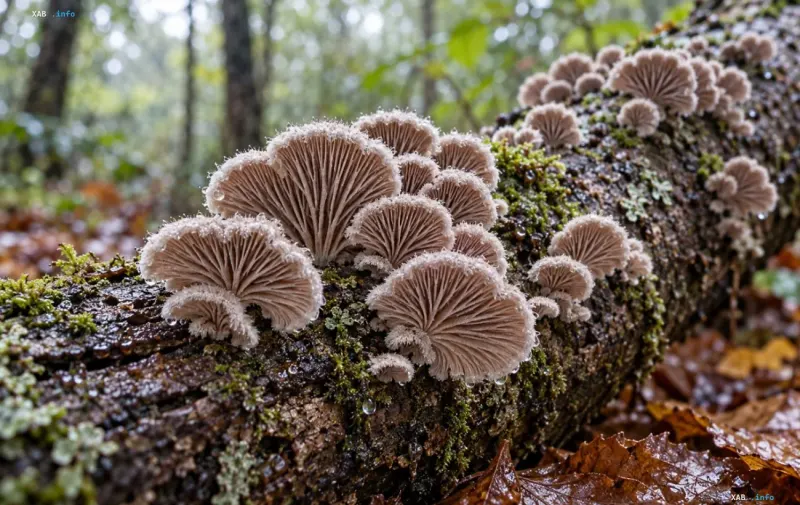
Schizophyllum commune inhabits dead wood: dry branches, fallen trunks, and old stumps of deciduous trees such as birch, oak, poplar, and willow. Its fruiting bodies often grow in groups, forming picturesque tiers resembling fans. They can be noticed from late summer to late autumn, and in mild weather, they persist on trunks even in winter when most other mushrooms have already disappeared.
The main external feature of the mushroom is hidden on its underside. Instead of traditional gills, it features folds with split edges—precisely this anatomical detail gave the species its name. The cap has a grayish-white hue, is covered with fine pubescence, and the stem is either microscopically small or completely absent.
Unique Survival Mechanism and Drought Tolerance
The primary property of the split-gill mushroom is its incredible resistance to drought. In dry weather, the fruiting body wrinkles heavily, becomes rigid, and the edges of its folds curl tightly inward, protecting internal structures. After precipitation, the fungus absorbs moisture, instantly softens, and straightens out, thereby resuming the formation and dispersal of spores.
This natural phenomenon attracts the attention of mycologists and researchers studying the genetic structure of Schizophyllum commune populations in various climatic zones of Europe, including Ukraine and Poland. The ability to endure multiple cycles of drying and rehydration makes this organism a valuable subject for scientific research in fungal adaptation.
Food Status and Culinary Use Worldwide
From the perspective of traditional mushroom foraging in Ukraine, the split-gill is considered inedible due to its thin, tough, and leathery flesh. Mycologists do not recommend consuming it without precise identification, especially since independently searching for wild mushrooms based on photographs always carries risks.
At the same time, in some parts of the world, this species has found culinary applications. For instance, in certain regions of India, it is boiled and served as a vegetable dish or added to soups, while in Indonesia and Central Sulawesi, people prepare split-gills with eggs, pepper, vegetables, and coconut milk, having previously dried and soaked the flesh to soften its texture.
Significance and Prospects of Studying the Unusual Species
The study of Schizophyllum commune goes far beyond simple regional botany, demonstrating the full diversity of living nature's adaptive strategies. The ability to exist in environments with fluctuating humidity underscores the complexity of evolutionary mechanisms that help fungi survive in the harshest environmental conditions.
Although Ukrainian forests are rich in this species, its value is purely scientific and educational. It serves as a striking example of natural resilience, reminding us how hidden and astonishing life can be, even for the most inconspicuous forest inhabitants.