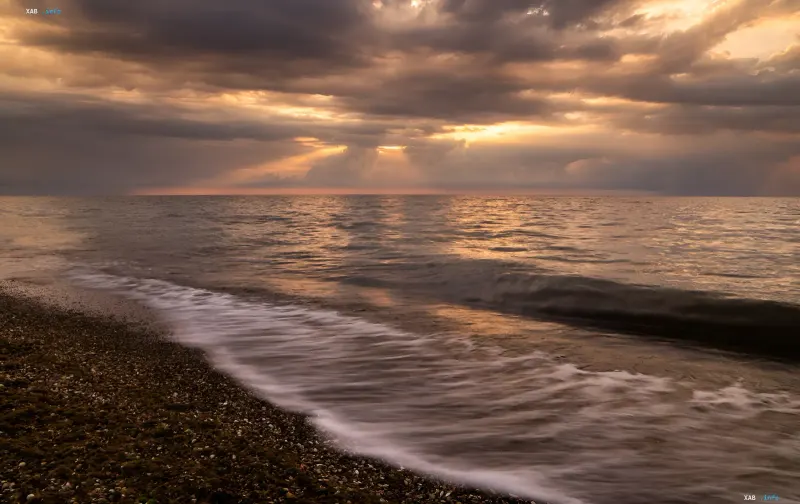
On August 14, 2026, locals and tourists on the Odesa coast witnessed a remarkable natural phenomenon: the night sea began to glow with bluish-green hues. Footage published on social media shows waves rolling onto the shore, seemingly illuminated from within, creating the effect of a "glowing river" against a dark backdrop. This spectacle, often referred to by the public as the "phosphorescent sea," has attracted the attention of both nature enthusiasts and the scientific community.
Bioluminescence: Science vs. Myths
While social media often attributes the phenomenon to the presence of phosphorus, the scientific community offers a different explanation. Based on the visual signs recorded off the coast of Odesa, this is bioluminescence — the ability of living organisms to emit light. This is not a chemical reaction involving minerals, but rather the result of the life activities of millions of microscopic creatures inhabiting the Black Sea. It is they that transform an ordinary wave into a spectacular blue glow, reacting to mechanical impact.
The Role of Noctiluca and Seasonality of the Phenomenon
According to expert assessments, one of the main causes of such glowing is the massive seasonal development of a unicellular organism — Noctiluca (Noctiluca miliaris). Marine biologist Sergey Khutorny previously noted that in late summer and early autumn, the water near Odesa can glow with bright flashes in the surf zone or with greenish-blue streaks during water movement. The glow becomes particularly noticeable at night when waves crash against the shore or when people and vessels move through the water, stimulating the microorganisms.
Contradictory Data
Despite the obviousness of the visual effect, there are discrepancies in the interpretation of specific data for the current date. On one hand, users of the "Odesa Afisha" Telegram channel and other witnesses record the phenomenon as a mass and bright event on the night of August 14. On the other hand, at this moment, there is no separate official scientific conclusion or report from scientists confirming the specific type of microorganism that caused the flash on this particular night. Experts note that in different years, the cause of bright glowing can be different types of microorganisms capable of bioluminescence, so the exact identification of the "culprit" of the glow requires laboratory analysis of water samples, which still needs to be conducted.
Uniqueness for the Black Sea
For the Black Sea area, this is not a unique phenomenon. Similar bioluminescence is observed seasonally, particularly in late summer, and is a natural process. However, the intensity of the glow can vary from barely noticeable streaks to powerful flashes that illuminate the entire coastal zone. The phrase "phosphorescent sea" remains a beautiful folk explanation, while the reality lies in a complex ecosystem where millions of tiny living organisms create a natural light show.