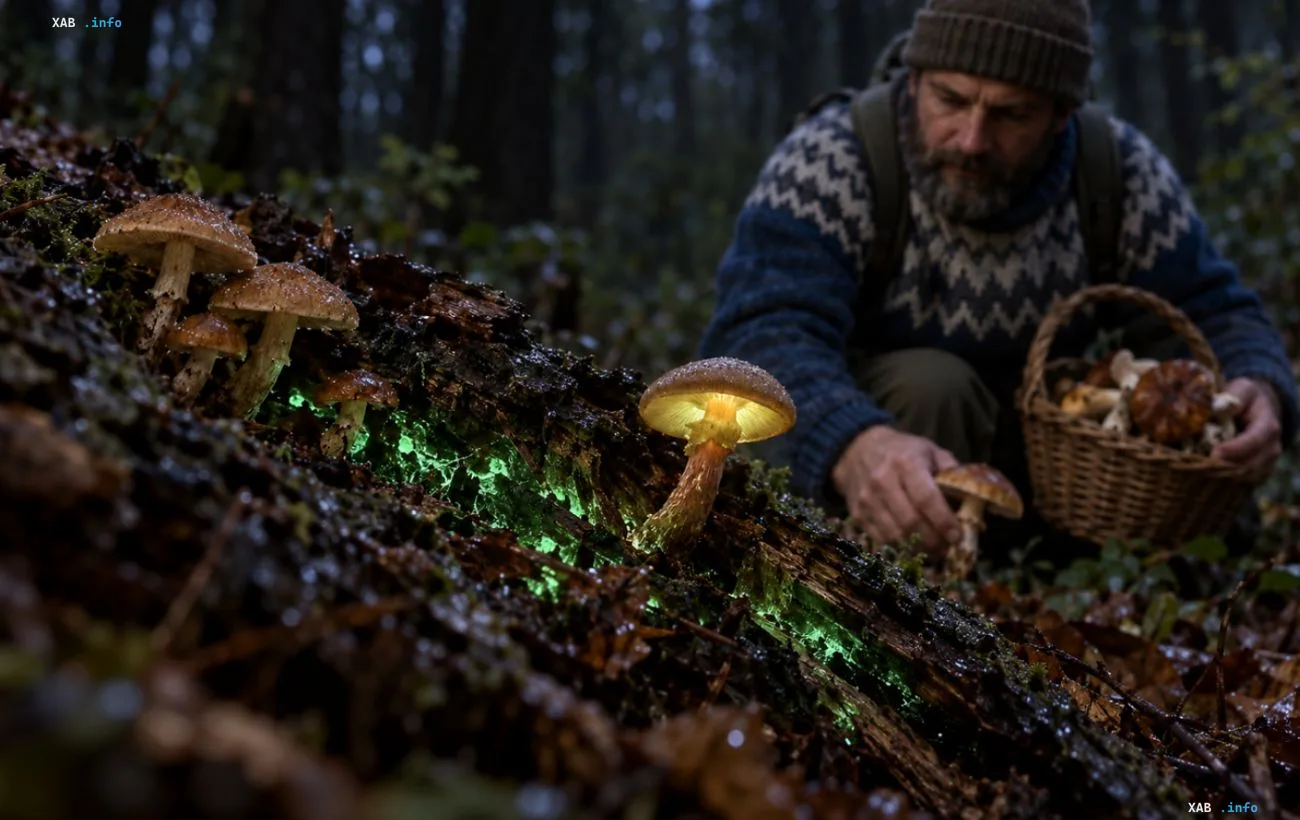
A glowing forest straight out of a fairy tale has become a scientific fact: bioluminescent fungi are not a myth but a perfectly real natural phenomenon driven by complex biochemical processes. Their faint greenish glow is barely noticeable during the day, and in some species it is not only the fruiting body that shines but also the mycelium developing inside the wood. According to the Sciencedirect portal, bioluminescence in fungi is linked to luciferin and enzymatic reactions in which energy is released precisely in the form of light. Around 125 species of bioluminescent fungi are known, represented by the genera Armillaria, Mycena, Omphalotus, Panellus and others. In Valery Sobol's school biology textbook, published in Ukraine in 2024, it is noted that to date more than a hundred such species have been described, while the biological significance of the phenomenon is still not considered fully established.
Why Does a Fungus Shine: The 'Lighthouse' Hypothesis for Insects
One of the most debated hypotheses in the scientific community links bioluminescence to the attraction of insects. A number of studies have shown that green light is capable of attracting certain invertebrates that theoretically carry spores on their bodies or contribute to their dispersal in some other way. By this logic, the glow acts as a kind of 'lighthouse' in the night forest, increasing the chances of reproduction. However, this theory cannot be called a universal rule: an experiment with the Australian 'ghost fungus' Omphalotus nidiformis, described in the PubMed database, found that its glow does not attract potential spore carriers. Scientists allow that the function of bioluminescence may differ among species, and in some cases it may simply be a by-product of metabolic reactions.
Contradictory Data
There are discrepancies in the scientific literature and popular sources regarding the number of bioluminescent species and their biological function. On the one hand, according to Wikipedia and a number of reviews, approximately 125 species are known; on the other hand, the 2024 Ukrainian textbook uses the figure 'more than a hundred'. The difference is explained by the fact that fungal taxonomy is actively updated, with new species described every year. A far more significant discrepancy lies in the interpretation of the glow's function: while some works emphasize the role of bioluminescence as an adaptation for attracting spore carriers, the experimental data on Omphalotus nidiformis directly refute this mechanism at least for this species. Thus, the question of 'why' fungi glow remains open and requires further research.
Can You See Glowing Fungi in Ukraine
Ukraine does have a representative of the genus Armillaria — the true honey fungus (Armillaria mellea), which is listed in the biodiversity database of the State Natural History Museum of the National Academy of Sciences of Ukraine. In this species, bioluminescence may be associated not with the cap but with the mycelium developing inside the wood. This is precisely why a person can notice a faint glow on old or rotting wood, even if the mushroom cap itself does not look 'glowing'. In folk tradition, this phenomenon is described as 'will-o'-the-wisp' or 'fox fire' — a cold, barely perceptible glow of rotting wood associated with the activity of fungi.
Why the Glow Is So Hard to Notice and Which Myths Should Be Dispelled
The intensity of fungal bioluminescence is extremely low: studies emphasize that it is insufficient for normal perception during the day, and at night the glow becomes noticeable only in complete darkness. Moonlight, a flashlight, or even a bright phone screen easily overwhelms the natural glow. The brightest bioluminescent fungi are concentrated mainly in tropical and subtropical regions, so one should not expect a 'forest lantern' effect with bright green light in Ukrainian forests. Another common myth is the claim that a fungus 'stores light' during the day and emits it in the dark. In reality, bioluminescence is an active chemical process, not phosphorescence: the fungus does not 'charge' from the sun; the light arises thanks to reactions occurring inside living tissues at the moment they take place. If at night in the forest an old stump seems slightly greenish, it is not mysticism — in nature there really are fungi capable of turning ordinary rotting wood into a very faint natural 'lantern'.