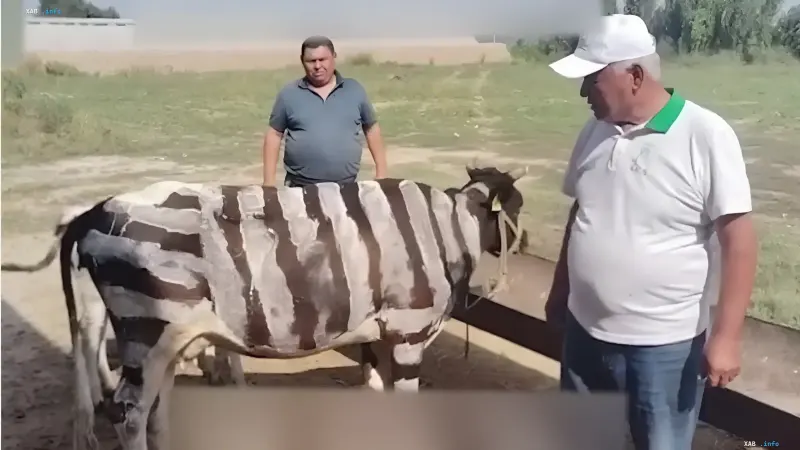
Videos are gaining popularity on social media showing farmers in Uzbekistan painting black and white stripes, resembling zebra patterns, onto the bodies of their livestock. At first glance, this unusual solution might look like a joke or an eccentric experiment, but it is actually backed by a serious scientific foundation aimed at protecting animals from annoying and harmful insects.
Scientific Origins and the Japanese Experiment
This innovative method was first tested in depth as part of large-scale scientific research conducted by Japanese specialists. In a study officially published in the reputable scientific journal PLOS ONE in 2019, scientists applied zebra-like patterns to the bodies of several cows. The experiment involved six heads of Japanese Black cattle. The results exceeded expectations: the number of biting flies landing on the animals with stripes dropped by nearly 50 percent compared to the control group of cattle without stripes.
Behavioral Changes and Animal Response
In addition to reducing the total number of parasites, researchers recorded important changes in the behavior of the test animals. Cows with artificial zebra stripes performed protective movements much less frequently, such as sharp head shaking, active tail swishing, and leg kicks to ward off annoying insects. According to biologists, the characteristic contrasting striped pattern visually disorients flies and horseflies, making it significantly harder for them to calculate the exact speed and trajectory needed to land on the animal's body.
Practical Application Worldwide and in Uzbekistan
The success of laboratory tests led to farmers around the world adopting the method. For instance, in 2024, reports emerged from Japan where farmers in Yamagata Prefecture began applying black and white stripes to livestock to protect them from blood-sucking parasites during the summer. The emergence of similar practices among Uzbek livestock breeders in 2026 logically continues this global trend of finding eco-friendly and inexpensive ways to increase agricultural productivity.