What if a parasite could not just kill its victim, but force it to perform a final mission that benefits the parasite itself? For some insects, this is not science fiction, but a real natural mechanism. Parasitic fungi are able to manipulate the host's behavior to successfully spread their own spores, and such organisms can be found even in temperate latitudes.
How zombie fungi work in nature
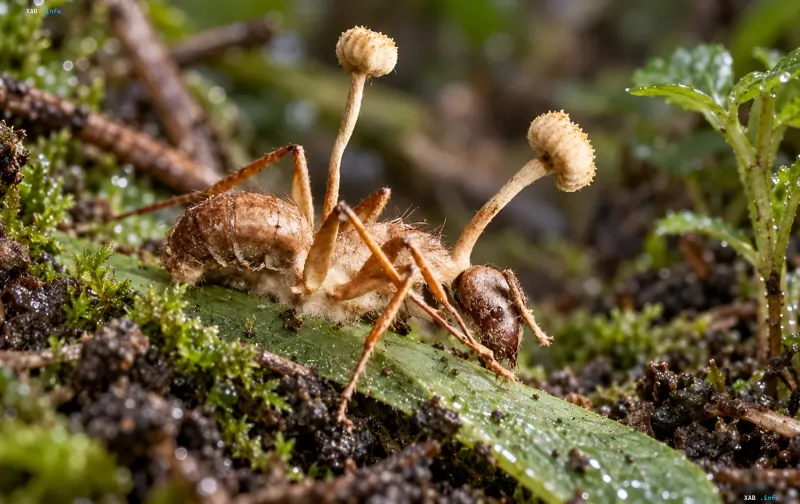
The most famous examples belong to the genus Ophiocordyceps, which parasitize insects. Penn State entomology professor David Hughes notes that the fungus does not literally take the wheel of the victim's brain. The mechanism is more complex: the parasite interacts with the host's organism through a set of chemicals and genes, leading to changes in the nervous and motor systems. An infected ant leaves the colony, climbs a plant, sinks its jaws into a leaf, and dies, allowing the mycelium to develop and release spores.
Evolutionary history and threat to humans
Scientists emphasize the high specialization of these fungi. In 2025, fossils about 99 million years old were found in amber, proving that such parasites existed back in the time of dinosaurs. Despite popular plots in pop culture, Ophiocordyceps are completely safe for humans and cannot turn a person into a zombie due to strict species specificity.
Can you find zombie fungi in Ukraine
Representatives of the genus Ophiocordyceps are recorded in Ukraine, but the famous ant species is not present here. Databases mention, for example, Ophiocordyceps cleoni, which parasitizes weevil larvae, as well as Ophiocordyceps clavulata, which infects scale insects. Thus, Ukrainian nature is rich in unique species of these parasites, but there is no need to fear an apocalypse.
Contradictory data
The scientific community still discusses the exact mechanisms of how parasites affect the nervous system of hosts. Some researchers focus on the direct chemical impact of fungal metabolites on the muscles and brain of the insect, while other experts emphasize the complex systemic impact on physiology as a whole. In addition, estimates of the total number of species in the genus Ophiocordyceps vary: mycologists confirm about 35 studied species, but suggest the existence of hundreds of undiscovered variants.