An unexpected discovery in Tanabe Bay
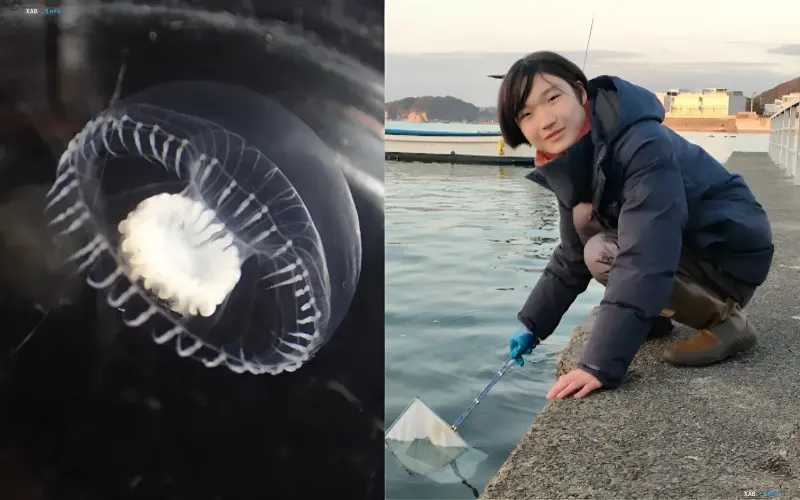
In the world of science, where discoveries are often made within the walls of high-tech laboratories using the most sophisticated equipment, there are sometimes surprising exceptions. The story we are telling today began in 2018 in Tanabe Bay, located in Wakayama Prefecture, Japan. Here, 13-year-old schoolboy Ryoya Sugimoto, while observing marine life off the coast during a routine outing, encountered a creature that would subsequently turn his life upside down and contribute to the global biological classification. The boy noticed several small jellyfish-like organisms near the pier, which immediately attracted his attention with their unusual nature.
Sugimoto, being an avid lover of marine fauna, was well-versed in the diversity of hydrobionts. However, the creatures swimming in the water before him did not match any description from the books he was familiar with. They did not resemble any of the jellyfish he knew. This observation became the starting point for a scientific investigation that ultimately led to the description of a completely new species.
The path from hobbyist to researcher
Sugimoto's interest in jellyfish was not accidental. His hobby began in early childhood. After an accidental contact with a blue button jellyfish (Porpita porpita), the boy began to independently study literature in the local library, trying to figure out the classification of these amazing creatures. It was precisely this base of knowledge that allowed him to understand that the organisms in Tanabe Bay were something unique.
Realizing that he had encountered something unknown, Sugimoto did not just observe them but decided to collect several specimens for home keeping. This decision proved to be key. As the organisms grew in captivity, their external characteristics became more distinct and interesting. The young researcher was particularly attracted to their reproductive system, which had an unusual twisted shape that had not been observed in previously described species.
International cooperation and scientific confirmation
Recognizing the value of his find, Sugimoto did not limit himself to his own observations. He took the initiative and contacted one of the leading world experts in the field of jellyfish systematics — Allen Collins, Director of the National Systematics Laboratory of the National Oceanic and Atmospheric Administration (NOAA) of the USA. Initially, Collins was not sure that it was a new species, however, the situation changed when Sugimoto provided preserved specimens for detailed study.
Scientists conducted a thorough analysis of the external structure and genetic characteristics of the organisms. The research results confirmed the Japanese schoolboy's assumptions: before the scientists was indeed a new species, previously not officially described in scientific literature. This discovery became a bright example of how citizen science can yield serious results with the right approach and interaction with the professional community.
The 'Integral Jellyfish' and its place in classification
The new organism was given the scientific name Orchistoma integrale. In popular press, it is often called the 'integral jellyfish'. Such a poetic name was not chosen by chance: the characteristic twisted shape of the reproductive organs of this species remarkably resembles the mathematical integral sign. This unique morphological feature became the calling card of the species.
It is important to note one interesting nuance regarding classification. Despite the external similarity and name, in strict scientific classification Orchistoma integrale is not considered a 'true jellyfish' (Scyphozoa). Scientists assigned this species to the group of hydroids (Hydrozoa). Although hydroids are close to true jellyfish, they are an independent group of organisms with their own biological features. Ryoya Sugimoto's discovery continues to expand our understanding of the diversity of life in the ocean, reminding us that even in the well-studied waters of Japan, science still has much to discover.