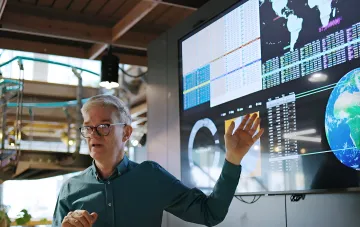
2024 Nobel Prize laureate in Economics, Turkish-American economist Daron Acemoglu has issued a stark warning regarding the consequences of the rapid development of artificial intelligence. According to his assessment, unless the trajectory of AI technology development is fundamentally revised, the traditional labor market could completely disappear within the next decade. Acemoglu, a professor at the Massachusetts Institute of Technology (MIT), pointed out that the ultimate goal of the artificial intelligence industry is to create a mind that surpasses all human cognitive abilities — so-called "superintelligence".
Disappearance of professions and contraction of employment
In his speech, Acemoglu detailed the scenario that, in his view, awaits the global economy. "If we even come close to such superintelligence, the labor market will completely disappear. As a result, only manual laborers, highly specialized engineers, or a small number of large entrepreneurs will remain," the scientist stated. Thus, most existing professional roles — from analysts and lawyers to programmers and middle managers — could be displaced by automated systems. Acemoglu emphasized that this threat will not arrive "today or tomorrow", but within the next decade, it risks becoming a "bitter reality" that all of humanity will face.
Risk to democratic institutions
In addition to economic consequences, the Nobel laureate drew attention to the political dimension of the problem. According to him, the uncontrolled development of superintelligence carries the risk of the collapse of democratic institutions, which form the basis of state governance and civil society. The concentration of technological power in the hands of a limited number of corporations or states could lead to an asymmetry of influence, where traditional mechanisms of accountability and public control cease to function normally. Acemoglu links this threat to the devaluation of the workforce: when millions of people lose economic significance, the social base of democratic systems weakens.
Proposed solutions: redirection, not replacement
To prevent a global economic crisis, Acemoglu proposed a concrete alternative strategy. Artificial intelligence, in his view, must be redirected: instead of completely replacing humans, the technology should serve as a tool to enhance labor productivity and assist workers. The priority of technological development, the economist argues, should be satisfying human needs and creating new opportunities, rather than leaving millions of people jobless. This approach implies that AI will be integrated into existing production and service chains as an auxiliary element that enhances rather than displaces human capital.
Who is Daron Acemoglu
Daron Acemoglu is one of the most influential economists of our time, specializing in institutional economics and development. He is a fellow of the Canadian Institute for Advanced Research, the American Academy of Arts and Sciences, the US National Academy of Sciences, and the Turkish Academy of Sciences. In 2024, jointly with Simon Johnson and James Robinson, he was awarded the Nobel Prize in Economics "for studies of how institutions are formed and how they affect prosperity." His scientific reputation and institutional affiliation with the world's leading academic structures give his warnings about AI risks additional weight in public discussion.
Acemoglu's warning emphasizes that maintaining a balance between human labor and artificial intelligence over the next decade will directly depend on strategic decisions made at the level of states, corporations, and international organizations right now. The issue is ceasing to be purely technological and is rising to the level of global economic and political security.