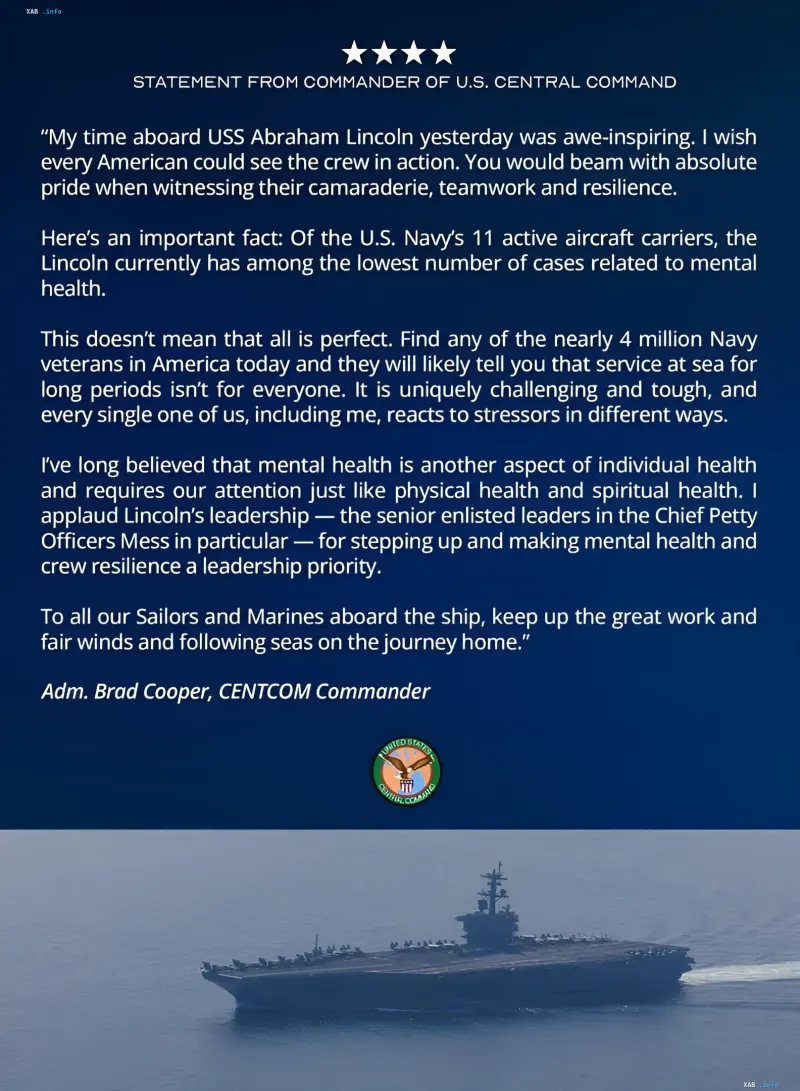
On August 16, 2026, Admiral Charles Cooper, Commander of the U.S. Central Command (CENTCOM), visited the nuclear-powered aircraft carrier USS Abraham Lincoln (CVN-72), deployed in the Arabian Sea. The official purpose of the trip was to personally familiarize himself with the crew's service conditions and inspect the state of the ship, which is performing tasks as part of the operation to deter the Iranian threat. The Admiral's visit took place against the backdrop of widespread public resonance caused by the emergence of video footage on social networks demonstrating problems with sanitation systems on board.
Reason for Inspection: Viral Video and Command Response
The trigger for the visit by senior command was a video recorded by a technical service sailor and published on social media. The footage showed malfunctioning sanitary facilities in the ship's living quarters, sparking a wave of discussions about living conditions in the fleet. In response to these reports, Admiral Cooper personally arrived at the scene to assess the situation and hold talks with the personnel. This step was taken to demonstrate the leadership's attention to the crew's problems and prevent the escalation of discontent.
Assessment of Crew Morale
During his address to the sailors, Admiral Cooper emphasized the professionalism and resilience of the crew. According to him, despite the difficult service conditions in the combat zone, the mental health indicators of the USS Abraham Lincoln team remain among the best among all U.S. Navy carrier strike groups. The Commander stressed that the crew demonstrates high adaptability and the ability to perform combat tasks under conditions of increased tension, calling the sailors a "model of naval fortitude".
Systemic Challenges: Infrastructure Wear and Logistics
Experts note that the incident with the sanitation systems reveals deeper problems in fleet operations. The aircraft carrier USS Abraham Lincoln has been in service since 1989, and its engineering systems, including the vacuum sewage system, are under critical load due to age and continuous combat service. In conditions where the ship cannot enter port for major repairs, maintaining the operability of infrastructure becomes a difficult task. Furthermore, the Pentagon's logistical resources are currently focused on delivering weapons and ammunition to the conflict zone, which limits the ability to operationally replace worn life-support units.
Contradictory Data
There is a discrepancy in the interpretation of the situation between official statements by the command and the opinion of independent observers. On the one hand, Admiral Cooper emphasizes the low level of mental disorders and the high combat readiness of the crew. On the other hand, critics point out that such "praise" may be an attempt to mask systemic problems that, in the long term, could lead to a decline in service efficiency. Last year, similar problems on other fleet ships led to serious incidents, which makes experts cautious when assessing the current situation.
Humanitarian Aspect and Prospects
Against the backdrop of a protracted conflict in the Middle East, issues of ensuring decent living conditions for military personnel acquire special significance. Admiral Cooper also touched upon the importance of maintaining humane service standards in his speech, stating that the command is doing everything possible to improve the situation. However, given the current priorities in resource allocation, a complete solution to infrastructure problems may take time. In the near future, it is expected that Pentagon inspectors will conduct a detailed assessment of the state of all carrier groups deployed in the region to develop a comprehensive modernization plan.