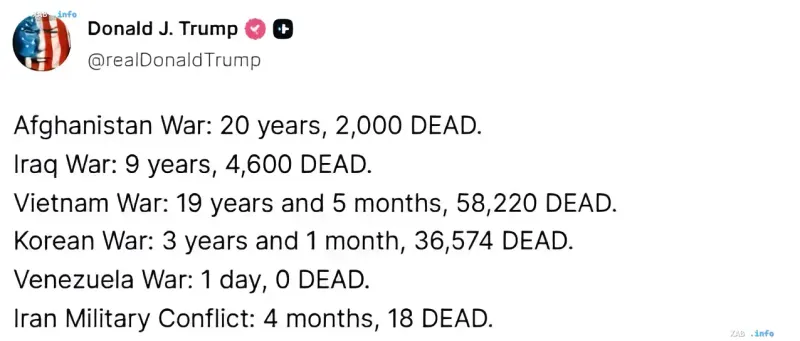
On July 20, 2026, US President Donald Trump made a bold statement that instantly divided public opinion and forced experts to reassess the scale of the current escalation in the Middle East. On his official Truth Social page, the head of state published comparative statistics on US military casualties, contrasting the cost of current operations with figures from historical wars.
The Cost of Conflict: Numbers That Speak Louder Than Words
The focus of the post was the sharp contrast between the prolonged, drawn-out campaigns of the past and the current events of 2026. Trump cited data confirming that the scale of human casualties during operations in his second presidential term is incomparable to previous wars, despite the intensity of the fighting.
According to the registry presented, which covers key US foreign operations over the last century, the picture looks as follows:
- Vietnam War (1955–1975): Approximately 58,220 military personnel killed. This is the bloodiest operation on the list, lasting more than 19 years.
- Korean War (1950–1953): 36,574 killed over 3 years and 1 month.
- Military Operation in Iraq: 4,600 killed over 9 years.
- Military Operation in Afghanistan: Approximately 2,000 killed over 20 years.
Special attention in the post is paid to the events of 2026, which, according to Trump, demonstrate the effectiveness of the new strategy:
- Operation in Venezuela (2026): The duration was only 1 day, with 0 casualties.
- Military Conflict with Iran (2026): Over 4 months of hostilities, casualties amounted to only 17–18 people.
Data Sources and Operational Statistics
The figures provided by the President regarding historical wars correlate with official historical summaries from the US Department of Defense. According to the text, data on the Iranian campaign reflects operational statistics from the US Central Command (CENTCOM). This figure includes military personnel killed as a result of ballistic and drone attacks on US facilities in the region.
Legal Classification and Political Context
The text of the publication applies a strict terminological distinction: the confrontation with Iran is classified as a "military conflict" rather than a war. From the perspective of US constitutional law (Article I, Section 8) and the War Powers Resolution of 1973, this formulation reflects the conduct of hostilities by executive decision without a formal declaration of war by Congress.
The head of state's publication coincided with budget hearings in the US Senate. During the sessions, the Department of Defense leadership was questioned regarding the dynamics of financial expenditures, which amounted to $37.5 billion by July 2026.
Criticism and Alternative View
Despite the President's optimistic figures, representatives of veterans' organizations and specialized analysts are calling for caution in interpreting the data. Experts point out the need to account not only for irrecoverable losses (death of military personnel) but also for medical indicators of sanitary losses. This category includes concussions and moderate injuries sustained by personnel at deployment sites in the Middle East region, which may not be included in official death statistics but significantly affect combat readiness.
A reminder of the US War Powers Resolution of 1973 also sounds in the context of the discussion: the use of armed forces abroad without a declaration of war requires mandatory notification of Congress within 48 hours and is limited to a 60-day period of force application without special legislative sanction.