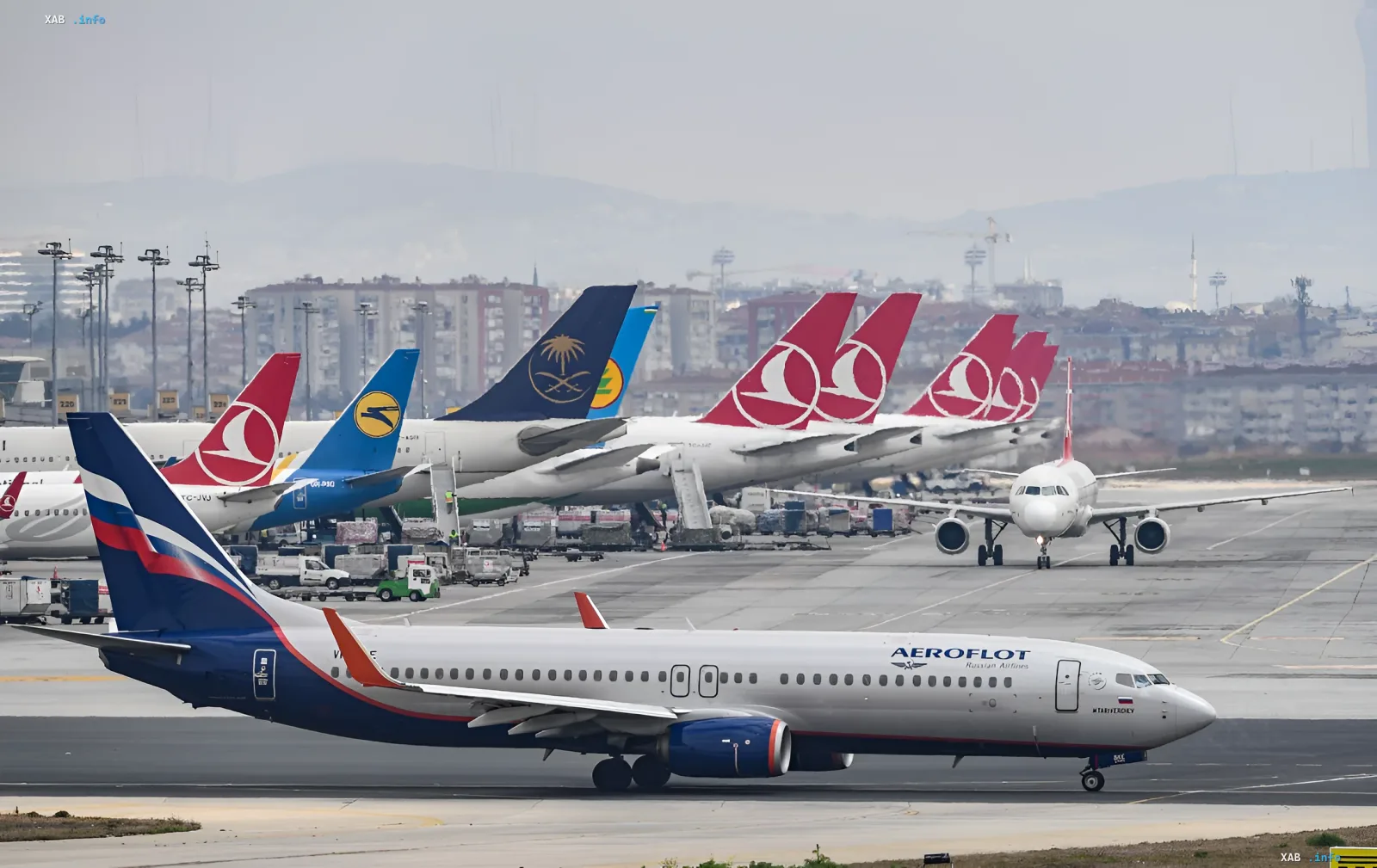
Shares of Russian carrier Aeroflot on the Moscow Exchange lost more than 5% of their value within a short period after Ukrainian President Volodymyr Zelensky publicly warned international airlines and insurance companies about the dangers of flying in Russian airspace. According to the trading platform, at around 20:40 Moscow time the stock price fell by 5.11%, dropping to a low of 30.36 rubles per share. The sharp price movement coincided in time with the Ukrainian leader's address, which was delivered that same evening.
Share Price Collapse on the Moscow Exchange
According to data from the Moscow Exchange, the decline occurred during evening trading hours: by 20:40 Moscow time, the value of an Aeroflot share had fallen by 5.11% and reached the level of 30.36 rubles, which became the day's low. The market reacted to the news almost instantly, indicating the high sensitivity of investors to any statements touching on flight safety and the operational risks of Russia's largest air carrier.
Zelensky's Statement on 'Closed Skies'
In his evening address, Volodymyr Zelensky stated that Ukraine is "beginning to close the sky over Russia." According to him, Russian airspace is becoming dangerous for civil aviation due to the mass presence of drones, and in this connection Kyiv is warning international airlines and insurance companies to take these risks into account when planning flights and arranging insurance coverage. At the same time, the Ukrainian president emphasized that his country does not threaten civil aviation, positioning the warning as a signal of actual danger rather than an intention to target passenger flights.
Moscow's Reaction and Threats of Strikes on Energy Infrastructure
In response to Zelensky's statement, Vladimir Putin threatened a "response," calling the rhetoric about "closed skies" a "claim to state terrorism" and stating that Moscow does not negotiate with terrorists. According to him, he has already ordered the preparation of massive strikes on Ukraine's corresponding energy infrastructure. Thus, the public warning about risks to aviation has escalated into a new round of rhetorical escalation between the two capitals, further increasing the uncertainty that the market is factoring into the carrier's share price.
Contradictory Data
The statements of the parties and the assessments of experts contain a number of inconsistencies that are important to take into account. First, Zelensky's formulation that Ukraine is "closing the sky over Russia" is predominantly rhetorical in nature: physically, the Ukrainian side does not control Russian airspace, and the real source of risk, in his own words, is not deliberate action against flights but the mass presence of drones. Second, the sources contain contradictory information about the status of the previously discussed plan to attack Moscow's airports: media reported that at the beginning of the year Ukrainian officials allegedly proposed such a plan to Zelensky, but it was suspended. At the same time, the current warning about "closed skies" and the mention of the mass presence of drones may be interpreted by observers as a sign that drone-related operations have not been reduced to zero, which is inconsistent with the thesis of a full suspension of the plan. The various versions — from "the plan is frozen" to "activity continues" — remain in the public domain without unambiguous confirmation.
Context: Plan to Attack Moscow's Airports
For the sake of completeness, let us recall that the media previously reported: at the beginning of the year, Ukrainian officials allegedly proposed to Zelensky to attack Moscow's airports with drones, but the plan was then suspended. According to press reports, it envisaged launching up to 1,000 drones per day at Moscow's airports and the surrounding area — these were cheap autonomous devices that were supposed to independently find and strike targets without operator involvement. It is precisely this context that makes the statement about "closed skies" particularly sensitive for the market: investors associate it with real risks to infrastructure and schedules, which is reflected in Aeroflot's share price.