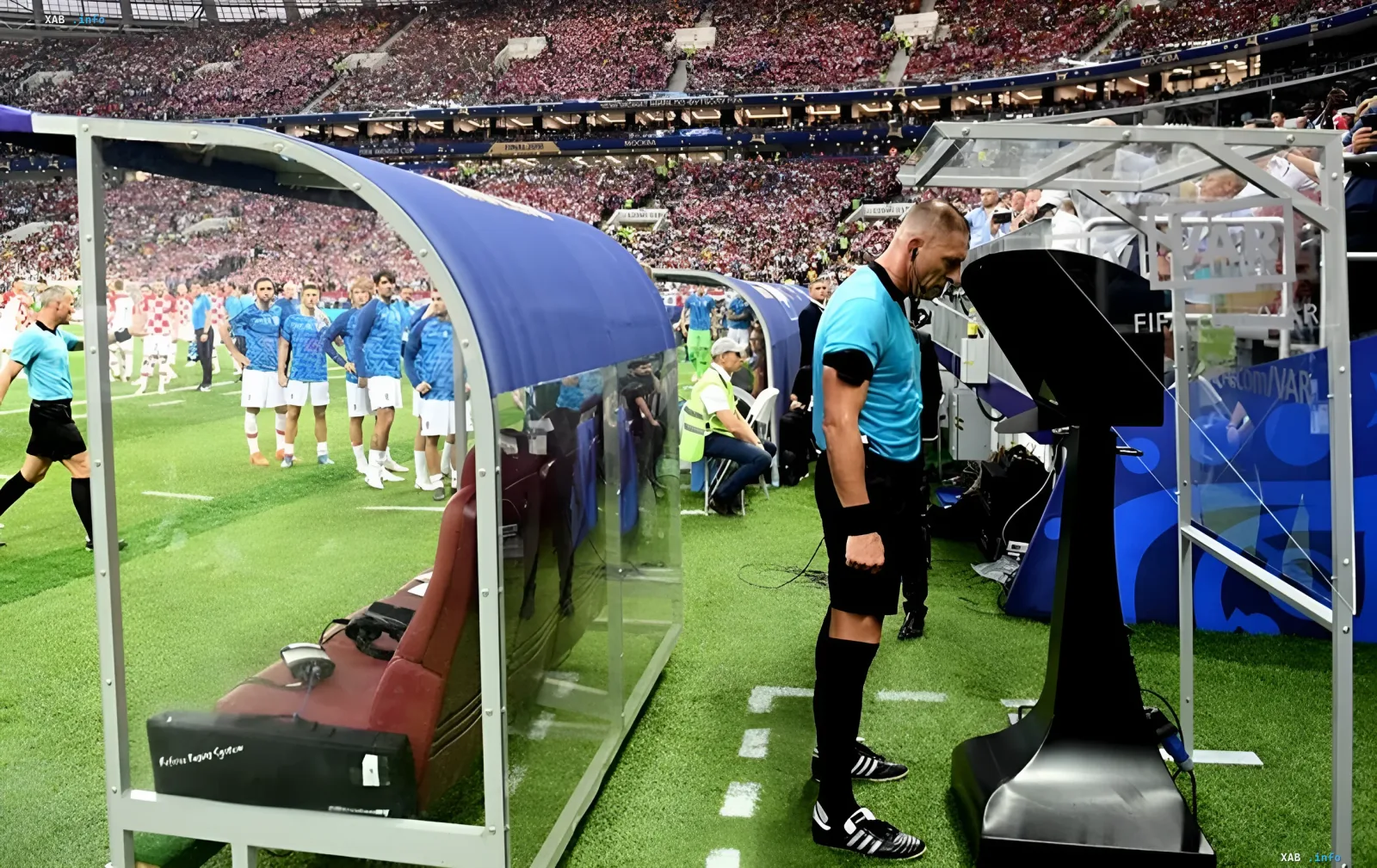
The opening rounds of the new Ukrainian Premier League season have already provided plenty of fuel for heated debate around refereeing: accusations of favouring certain clubs, complaints from others, disputes over VAR, and various expert assessments. However, as Mikhail Metreveli notes in his column for Sport RBC.UA, one should not rush to the conclusion that the main problem in Ukrainian football has once again become the referees' gross mistakes. A professional breakdown of the most resonant episodes of the championship's opening leads to a more complex and, in essence, global problem: football has still not learned to guarantee identical decisions in identical or maximally similar game situations.
The Bilovar Episode: When 55/45 Becomes a Field for Speculation
One of the season's first high-profile episodes occurred in the Veres — Dynamo match. Bilovar's foul was widely perceived as an obvious DOGSO (Denial of an Obvious Goal-Scoring Opportunity), and calls were made to send off the Kyiv club's defender. The referee showed a yellow card, and talk of "helping" Dynamo immediately surfaced. However, according to RefScore data, the episode was assessed at 55% in favour of a yellow card and 45% for a red. In other words, the referee's decision was deemed justified, even though the episode itself was classified as difficult and close. The position in favour of the yellow card was also supported by Nicola Rizzoli, the curator of Ukrainian refereeing. It is precisely here, in Metreveli's view, that a far more important question arises: what will happen if, a few rounds later, a virtually identical episode occurs with a Shakhtar, Polissya, or Kryvbas player — and the referee shows a red? The club will logically ask: why was one player not sent off, while the other is? And answering that will be significantly harder than answering a question about a specific mistake.
International Practice: One Set of Rules — Different Decisions
The problem of inconsistency is not limited to Ukrainian football. In an English Premier League match between Liverpool and Chelsea, Tosin Adarabioyo fouled Diogo Jota far from goal. The referee showed a yellow card, the decision was not changed after a VAR check, and it subsequently received support in England. Meanwhile, in the Czech championship, an episode involving a potential DOGSO that occurred roughly 60 metres from goal — effectively still on the defending team's half — was initially assessed with a yellow card, but after VAR intervention the decision was changed to a red. The same rules of the game, the same DOGSO criterion — yet different decisions. Metreveli emphasises: this is no longer a problem of a specific Ukrainian referee, but a problem of modern football as a whole.
Shakhtar's Penalty and Two Levels of the Problem
Another telling episode of the season occurred inside Shakhtar's penalty area: Yehor Nazaryna aggressively attacked an opponent in a challenge for the ball. A penalty was not awarded, and VAR did not intervene. RefScore assessed the episode at 55% in favour of a penalty, and Nicola Rizzoli also believes that a penalty should have been awarded in this situation. Thus, on the question of the foul itself, the positions coincide. However, regarding the role of VAR, a fundamental disagreement emerges, revealing the second level of the problem.
Contradictory Data
In the Nazaryna episode, the positions of RefScore and Nicola Rizzoli diverge on the question of VAR intervention. Rizzoli believes that VAR should have intervened and changed the decision. RefScore, by contrast, points out that the 55/45 ratio indicates a very fine line of interpretation, and questions whether the initial decision was so "clearly wrong" as to require mandatory VAR intervention. Both positions rely on the same episode and the same rules, yet they reach opposite conclusions about the permissibility of intervention. This clearly demonstrates that football still lacks a unified standard not only for assessing the episode itself, but also for defining the threshold at which VAR is obliged, rather than merely able, to intervene.
Mistake vs. Inconsistency: What's the Difference
Metreveli emphasises: referees made mistakes a hundred years ago, they make them today, and they will make them a hundred years from now. It is impossible to completely remove the human factor from football — and, in the author's view, it does not need to be. But between a mistake and a lack of consistency there is an enormous difference. A player must understand for which specific action he will be sent off the field. A coach must understand which contact in the penalty area will be classified as a penalty. A club must be confident that the same criteria are applied to Dynamo, Shakhtar, Polissya, Veres, or any other team. It is precisely the absence of such confidence, rather than isolated mistakes, that gives rise to the greatest number of refereeing scandals.
VAR — A Revolution That Was Not Completed
The introduction of VAR was a genuine revolution in refereeing. Before, the referee saw an episode once, from a single angle, within a fraction of a second. Today it can be reviewed from five, ten, or fifteen cameras, the frame can be paused, the image zoomed in, and replays watched at different speeds. We see much better what happened. However, as Metreveli concludes, there remains another, still unresolved question: what are we comparing what we see against? Without a single database of standardised decisions on similar episodes, even an ideal video technology cannot guarantee consistency. The next revolution in refereeing should not be a new camera or a new algorithm, but the building of a unified assessment system in which identical situations receive identical decisions — regardless of which championship and which stadium they occur on.