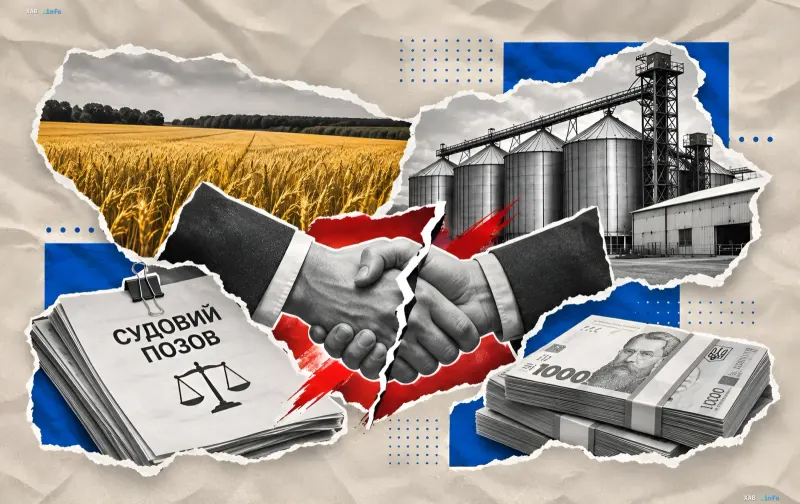
One of the largest agricultural corporate disputes of recent years is unfolding in the Poltava region. A story that until recently was a profitable enterprise with thousands of hectares of land, own machinery, elevators, and production infrastructure has now turned into a chain of lawsuits and criminal proceedings. Former co-owners are trying through the courts to recover the market value of their shares, and transactions involving the property and finances of the enterprises have come under the scrutiny of law enforcement agencies — from the Bureau of Economic Security and the National Police to the Office of the Prosecutor General.
Scale of Business: Nearly a Billion Hryvnias in Assets
At the center of the conflict is a group of agricultural enterprises: AGRO PEREBOGA LLC, CHBG Agricultural Firm LLC, VINKOR-AGRO SIVER LLC, FRUKTY POLTAVSHCHYNY LLC, and ZORYA-AGRO Agricultural Firm LLC. Until August 2023, the business belonged to three partners: Konstantin Nekrasov, Ilya Vyaloy, and Valery Oroshan. In the three main companies, the shares were 70%, 20%, and 10% respectively; in FRUKTY POLTAVSHCHYNY, Vyaloy and Oroshan each held 25%, and ZARYA-AGRO was fully owned by the CHBG agricultural firm. The holding included about 19,000 hectares of cultivated land in the Poltava and Chernihiv regions, horticulture, own machinery, transport, production bases, warehouses, and fuel depots; AGRO PEREBOGA possessed elevator capacities for approximately 80,000 tons of storage, cleaning complexes, and railway cars.
Financial Picture Before and After the Conflict
According to financial reports, as of January 1, 2024, the group's assets were estimated at 952.6 million hryvnias, with gross revenue of about 908 million hryvnias. In the first half of 2023 alone, the combined profit of the enterprises exceeded 180 million hryvnias, and retained earnings, according to the balances cited in the reference, reached 669 million hryvnias. At the same time, according to open registries (Opendatabot), Konstantin Nekrasov is currently the 100% owner and director of AGRO PEREBOGA LLC, and the assets of this enterprise alone for the three quarters of 2026 exceeded 1 billion hryvnias with a net profit of almost 152 million hryvnias. That is why the issue of the value of the former co-owners' shares and the fate of the enterprises' property has become central to this story.
Chronology of the Conflict According to the Applicants
According to Ilya Vyaloy and Valery Oroshan, the turning point was August 7, 2023: they claim that Konstantin Nekrasov demanded the transfer of their respective shares — 20% and 10% — and after their refusal, actions began that they view as an attempt to establish sole control over the enterprises. As early as August 9, according to the applicants, the bank accounts of the agricultural companies opened in Poltava-Bank were blocked, which they attribute to the potential influence of the Nekrasov family on the bank. On August 17, 2023, the former partners claim, using falsified general meeting minutes dated August 15, the directors of three key enterprises — AGRO PEREBOGA, CHBG, and VINKOR-AGRO SIVER — were replaced, previous directors were removed from management, and the applicants themselves were barred from the enterprises and denied access to information on economic activity.
Exit from Membership and Lawsuits
In December 2023, Vyaloy and Oroshan withdrew from the membership of CHBG LLC, in March 2024 — from AGRO PEREBOGA LLC, and in September of the same year — from VINKOR-AGRO SIVER LLC. However, the former co-owners claim they never received the payouts due for their shares. In 2025, Vyaloy, Oroshan, and other former participants applied to commercial courts with lawsuits to recover the market value of their shares. While the dispute is being resolved in courts, the asset structure of the enterprises continues to change: part of the assets changed owners or was re-registered to other structures during the conflict, becoming another direction of the corporate dispute.
Criminal Proceedings and Risks for the Agricultural Sector
The details of this story are being examined not only by commercial courts but also by law enforcement: the Bureau of Economic Security, the National Police, and the Office of the Prosecutor General have intervened in the case. Transactions involving the property and finances of the enterprises carried out amid the corporate conflict have become the subject of criminal proceedings. For the entire agricultural sector, this case is illustrative: it demonstrates the risks that arise for partners during wartime, when access to assets, bank accounts, and company management can become an object of struggle, and the valuation of shares and the legitimacy of transactions can become the subject of lengthy litigation. The outcome of the struggle for assets valued at nearly a billion hryvnias remains undecided.