Biotech startup Exin Therapeutics, specializing in next-generation neurotherapeutics, has announced the successful performance of a mouse brain surgery entirely planned and executed by an artificial intelligence agent. The system, based on the Anthropic Claude Sonnet model, independently selected the gene therapy vector, determined the dosage and the specific brain region for administration, and then controlled the robotic manipulators that performed the injection. The experimental animal tolerated the intervention well and, according to the company, is actively moving around in its glass terrarium. Exin Therapeutics CEO Gabriel Ocana-Santero emphasizes that there are no previous records of an AI agent choosing a treatment method, a brain region, and administering a drug to a living mammal without external prompts.
How the AI Developed the Treatment Plan
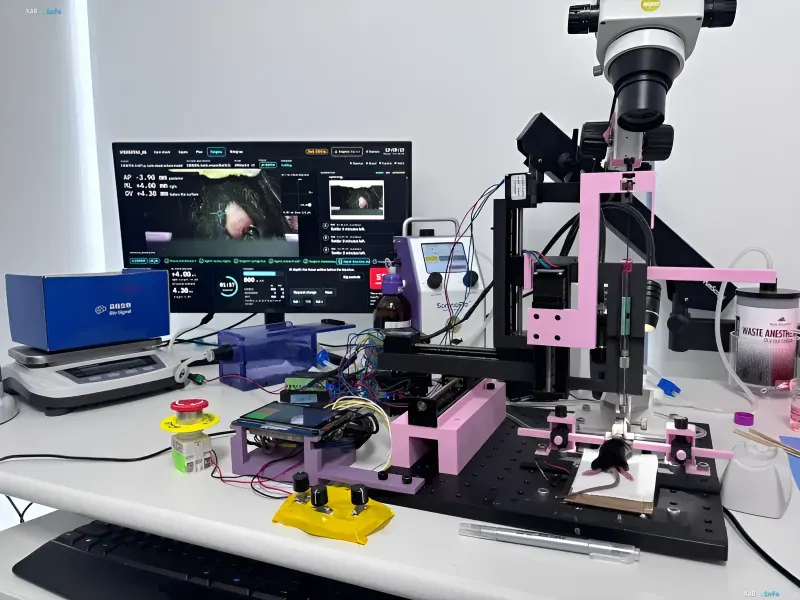
To conduct the experiment, epilepsy was artificially induced in a mouse. The AI agent, based on the Anthropic Sonnet model, was given control of a robotic surgical setup, access to a table containing 19 gene therapy vector options, and three scientific papers from which the system had to determine the target brain region for treatment. According to Ocana-Santero, unlike existing autonomous surgical robots that surpass Exin Therapeutics' laboratory setup in mechanics but always follow a human-made plan, this agent received only phenotype data and a list of potential therapeutic agents. Independent creation of the treatment plan, coordinate determination, and drug selection marked a key departure from previous work in robotic surgery.
Safety: A Human Remains on Guard
Despite the AI agent's autonomy in choosing the treatment tactics, a licensed veterinarian continuously monitored the procedure. Before every irreversible action, the system obtained explicit approval from the veterinarian before proceeding. The surgical setup was equipped with an emergency stop button that completely cuts power to all actuators. Craniotomy—opening the skull to access the brain—was performed manually by the veterinarian, as this task is not yet entrusted to the AI agent for safety reasons. Furthermore, the system incorporated safeguards that the AI agent was prohibited from bypassing; even human operators could not override them, and during the operation, agents' software code had to be manually edited to remove restrictions unrelated to patient safety.
Why Sonnet, Instead of Opus
To accomplish the task, the startup had to settle for a mid-tier AI model—Anthropic Claude Sonnet. Initially, deploying the more powerful Opus 5.5 was planned, but the model flatly refused to perform the work once it determined that a biological experiment was involved. An earlier version, Opus 5, managed to draft the operation plan on paper but also refused to execute it in real-time. In an explanation formulated for developers, the model stated: "The problem is not the hardware or the input data. It is me. My output blocks as soon as I start drafting the surgical plan. If I try to continue, access is cut off, and in the worst-case scenario, communication will drop right during the surgery while the needle is somewhere in the brain. Starting something I cannot finish with an animal under anesthesia is worse than not starting at all." This episode became one of the first publicly documented cases where an advanced LLM consciously refused to participate in a surgical intervention on a living organism.
Ethical Issues and Prospects
Although the operation is considered successful, experts point to a number of unresolved ethical problems. Large language models are actively used in medical research, but their application in sinus surgery has reportedly led to a more than 12-fold spike in errors. If AI makes decisions during such high-risk interventions, questions of legal and professional liability in the event of complications arise. The ethics of using animals in such experiments also remains a separate question without a definitive answer. On the other hand, patients suffering from drug-resistant epilepsy for decades still exist worldwide, for whom the prospect of personalized gene therapy planned and executed with sub-millimeter precision could be a breakthrough. Exin Therapeutics intends to continue its series of experiments, gradually expanding the range of tasks the AI agent will perform without human involvement.