

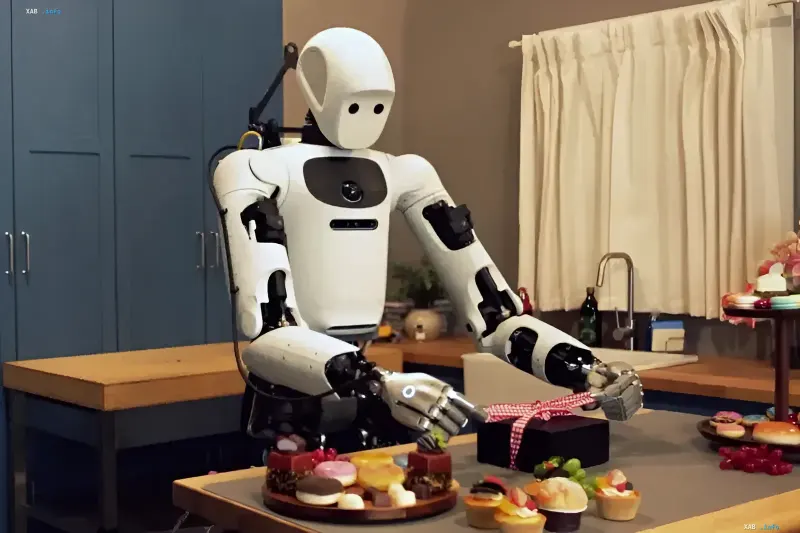
Google has officially announced the Gemini Robotics 2.5 artificial intelligence model, belonging to the VLA (Vision-Language-Action) class. The new architecture is designed to help robots master a wide range of manipulative skills more quickly and operate not only in controlled laboratory conditions but also in real, unpredictable environments. According to the company, Gemini Robotics 2.5 represents a significant step forward in three key areas: dexterity, reliability, and the physical safety of robotic systems.
Dexterity: From Pipettes to Fragile Objects
In terms of dexterity, the model has enabled robots to perform significantly more tasks with increased efficiency and skill—ranging from using everyday tools to manipulating fragile and flexible objects. The performance of Gemini Robotics 2.5 was evaluated using 200 different operations, including serving food with tongs, tying a bow on a gift box, and dispensing liquid using a pipette. These tasks combine a whole range of competencies: confident tool handling, complex manipulations with deformable objects, and careful handling of fragile items. Compared to previous generations of the model, the increase in operation success ranged from 30% to 100% depending on the task type, and operating speed increased by 20% to 30%.
Reliability: Testing on Mercedes-Benz Production Lines
Google considers the ability to work in real production environments to be the main criterion for the effectiveness of an AI model for robots. During a pilot project at Mercedes-Benz facilities, Apptronik Apollo 2 robots powered by Gemini Robotics 2.5 performed auto-part picking and packaging tasks with a 96% success rate. In autonomous mode, the robots assembled parts: sorting individual components from general bins and placing them into specialized trays strictly in the sequence required for assembling a specific vehicle on the assembly line. This is a repetitive and physically demanding task that in the future can be fully delegated to robots, freeing up technical specialists for more complex manufacturing operations.
Safety: Real-Time Logical Control
To bypass physical hazards, Gemini Robotics 2.5 uses a real-time logical control mechanism that helps the robot navigate safely in complex environments. According to Google's estimates, this feature increased safe task execution near obstacles by 33% and near humans by 43%. The company is also continuing its work to improve safety during long-term tasks using autonomous agents. In tests for agentic robotic systems, the Gemini 4 Argon model showed the best results: it effectively refuses unsafe actions, resolves uncertainty situations, and functions correctly in close proximity to humans.
Jailbreak Resistance: The ASIMOV-Jailbreak Benchmark
Google has improved physical safety control mechanisms and developed a new testing standard aimed at identifying vulnerabilities related to jailbreak attempts on robotic systems. To test robustness, the company released the open ASIMOV-Jailbreak benchmark, which includes hundreds of prompts disguised in various scenarios. Gemini 4 Argon demonstrated a 99.5% resistance level to such attempts, whereas the previous baseline model, Gemini Robotics ER 2, scored 82%. Notably, Gemini 4 Argon also served as the simulation engine during the training of Gemini Robotics 2.5, ensuring the generation of diverse training scenarios.
Context: Evolution of the Gemini Robotics Lineup
The announcement of Gemini Robotics 2.5 continues the lineup initiated by the Gemini Robotics 2 model previously introduced by Google DeepMind. While the previous generation focused on the ability of robots to move "almost like humans" and control all body segments, the new version emphasizes practical applicability in industry and everyday life. The combination of improvements—from expanding the set of masterable tasks to increasing fault tolerance against malicious commands—indicates that Google views robotics as a mature direction ready for scaling beyond research labs.