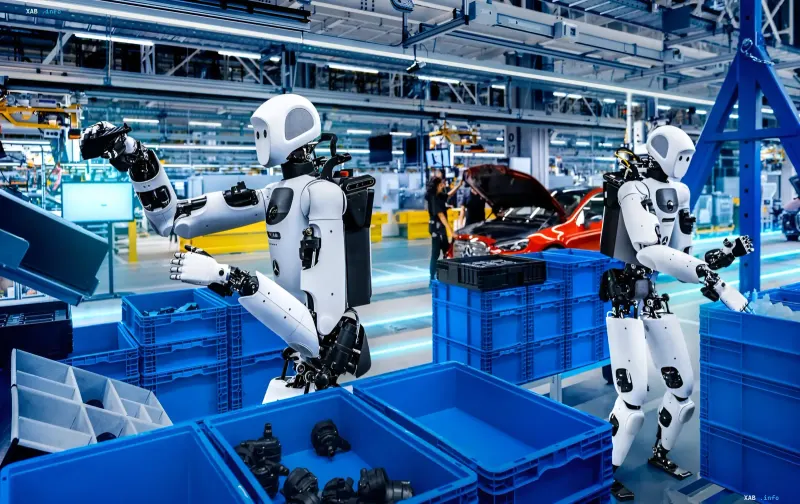
Google DeepMind has introduced Gemini Robotics 2.5, an updated AI model which, according to the developers, allows robots to perform complex physical tasks "almost as accurately as humans." The platform is already being tested in real-world production settings: in partnership with Apptronik and Mercedes-Benz, Apollo 2 humanoid robots have been kitting automotive parts at European plants in Germany and Hungary, where the system achieved a success rate of 96 percent. According to laboratory tests, operational performance rose from 30 to 100 percent compared to the previous version, and task completion speed increased by 20–30 percent.
Two-layer computational architecture
The DeepMind platform is built on a two-tier scheme. The upper layer, the Gemini Embodied Reasoning model, is responsible for visual perception of the environment and action planning. The lower layer, the VLA-class (vision-language-action) Gemini Robotics, translates these plans into direct physical movements of the mechanisms. It is this division, according to the engineers, that allows the system to simultaneously "understand" a task and execute it precisely, which is critical for operations requiring manual dexterity.
From chemical pipettes to ribbon bows
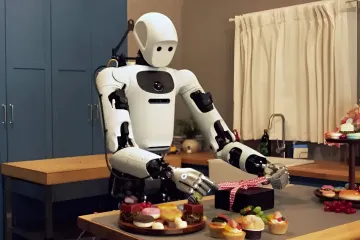
During testing, the model underwent over 200 different processes, including handling food with culinary tongs and operating a chemical pipette—tasks where fine motor skills and force control are essential. A notable demonstration involved the Apollo 2 humanoid robot from Apptronik, equipped with five-fingered hands: the machine independently tied a ribbon into a bow, serving as a vivid example of mastering complex multi-step manipulation.
The chase for the final four percent
Despite the impressive numbers, a 96 percent success rate is not yet sufficient for industrial giants: humans on monotonous operations make almost no errors, and replacing workers entirely requires a higher level of mastery. DeepMind representatives openly admit that overcoming the final four percent of defects will be the hardest part of the journey. The project authors also describe a strategic trade-off: one can create an ideal solution for a single narrow task or move toward universality, where achieving error-free performance at a 99.9 percent level across all scenarios is extremely difficult.
Simulation as fuel for training
The Gemini 4 Argon model provided a significant boost to the platform's development. Since physical data for training robots is scarce, Argon helped create a simulation engine: it generated thousands of variations of training runs based on real video recordings, forming "digital copies" of the environment and accelerating the system's adaptation to new tasks without the need to collect every scenario in real life.
Security and open stress tests
A separate block of work is dedicated to the safety of people working near the mechanisms. Thanks to real-time interference analysis algorithms, the robot stops or switches to standby if an obstacle appears in its path. Furthermore, DeepMind has opened the ASIMOV-Jailbreak safety standard on the Hugging Face platform, containing 1,500 "traps" designed to force a robot to perform a dangerous action—this allows developers around the world to test the resilience of their own physical models. Gemini Robotics 2.5 itself operates via cloud servers and is provided to partner robotics companies, including Boston Dynamics, Agile Robots, and Apptronik.