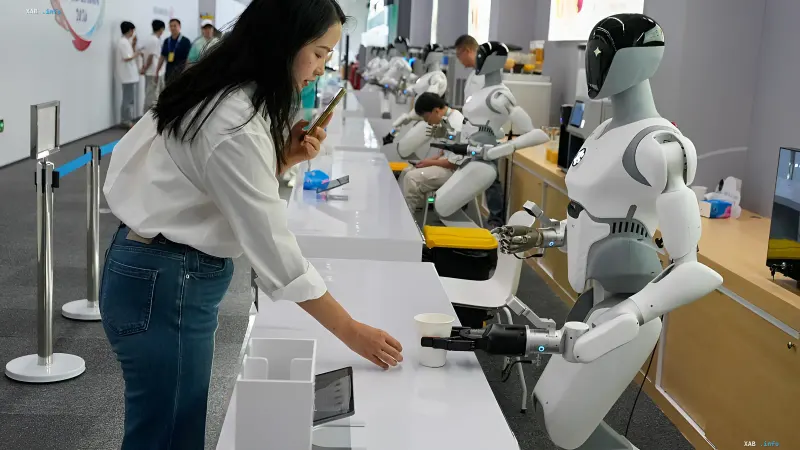
In a park in Shenzhen, China, humanoid robots are already serving visitors at a snack kiosk: one device makes ice cream, while another brews coffee. Both machines are controlled by artificial intelligence systems and attract curious passersby who film their work on video. However, the operation is not yet fully autonomous — employees still have to replenish ingredient supplies and dispose of used coffee grounds. Thus, the robots perform the main cyclical part of the process, while routine auxiliary operations remain the responsibility of humans.
Training on Real Worker Data
Chinese companies use a non-trivial approach to training their robots: workers in production and service locations wear cameras and sensor-equipped gloves that capture every hand movement. The collected recordings are fed into machine learning systems, where algorithms analyze gripping trajectories, pressure force, and the sequence of actions. According to Euronews, it is this data that helps machines master tasks such as handling packages, restocking shelves, and adapting to various working conditions. This method allows robots to transfer skills from one environment to another without complete reprogramming.
From Repetitive Operations to Everyday Tasks
Complex everyday chores — such as cleaning up messes or working with unpredictable objects — still remain beyond the capabilities of modern humanoids. Robots still struggle with them; however, in the realm of monotonous, repetitive operations, they are already demonstrating stable performance. Serving a drink or dessert according to a fixed algorithm, moving standard packages, displaying identical goods — these are precisely the tasks that first become delegated to machines. Experts note that it is at this stage that the "base" of skills is formed, upon which more complex scenarios will subsequently be built.
Shenzhen as a Testing Ground for Rapid Trials
A key factor in the accelerated integration of robots into Shenzhen's urban environment is its manufacturing network. The city, historically associated with electronics and mass production, features a dense ecosystem of component suppliers, assembly lines, and service centers. This allows developers to quickly prototype devices, test them in real-world conditions, and rapidly refine the design based on feedback. Unlike markets where supply chains stretch over months, in Shenzhen the "problem-refinement-retesting" cycle is shortened to days, accelerating the transition of robots from laboratories to public spaces.
What This Means for Everyday Life
The scenario featuring robot baristas and ice cream vendors in the park is not merely a demonstration for the media. It reflects a strategy of gradual integration: first, robots take on narrow, repetitive functions in a controlled environment, and then, as data accumulates and algorithms are refined, the range of tasks expands. For park visitors, this is still more of an attraction, but for developers, it is a living testbed where the system receives data on human interaction in an unstructured environment. According to observers, it is this exact approach that determines the pace at which humanoid robots will transition from exhibition halls to everyday service points across China.