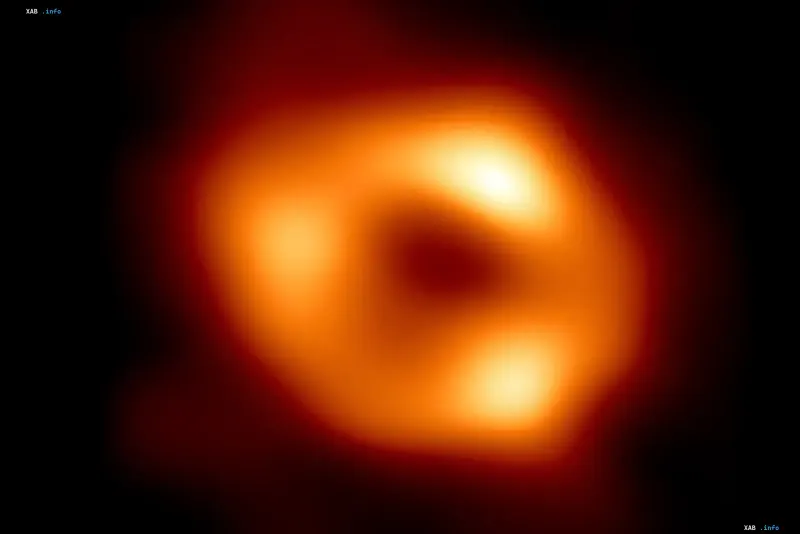
The famous image of the supermassive black hole M87*, published in 2019 by the Event Horizon Telescope (EHT) collaboration, has received independent confirmation using artificial intelligence. An Australian scientific team has developed the GenDIReCT algorithm, which re-processed raw radio data from the international EHT telescope network and independently reconstructed the characteristic glowing ring around the object. The resulting structure closely matched the result of the historical 2019 reconstruction, while the new method did not use a preset ring shape—it was derived directly from the data.
Why the EHT 'Photograph' Is Not a Photograph
The key challenge of working with EHT data is that the network of radio telescopes located at different points on Earth does not actually take a picture in the traditional sense. The stations work as a single virtual instrument the size of the planet: each records radio signals, and computer algorithms combine the measurements and reconstruct the image. At the same time, the virtual aperture that determines resolution is only partially filled. Because of this, the reconstruction task is mathematically ambiguous: different algorithms, settings, and calibration methods can produce differing images of the same observations. This is precisely why some independent data re-checks previously questioned the pronounced ring shape of M87*.
GenDIReCT: Diffusion Model and Calibration-Independent Parameters
The acronym GenDIReCT stands for Generative Deep learning Image Reconstruction with Closure Terms. The method is based on a latent diffusion generative model—a type of machine learning that creates images by gradually restoring their structure from noise. The fundamental difference of the algorithm, according to the authors, lies not just in the use of AI, but in the use of special parameters that allow extracting information about the source shape from radio data independently of calibration errors in individual telescopes. Thanks to this, the algorithm bypasses some of the problems of traditional reconstruction, which has to account for and correct measurement errors at each station.
Verification on Multiple Independent Observation Series
To verify the results, the team used open EHT data obtained in 2017, 2018, and 2021, which made it possible to evaluate the outcome not on a single set of observations, but on several independent measurement series. For each set, the algorithm generated images, after which the scientists combined them into a representative reconstruction. The training images for GenDIReCT were intentionally non-astronomical—mostly ordinary photographs from a training dataset. The team separately tested the model without geometric shapes in the training set, including rings and disks, and found no significant changes in the final image. The algorithm also did not require manually setting an initial black hole model or adjusting reconstruction parameters to match an expected result.
Results: Ring, Mass, and Limits of Applicability
Across all high-quality observation series, GenDIReCT reconstructed a ring structure with a diameter of about 40 microarcseconds. The final measurement was 42.2 ± 1.5 microarcseconds—virtually the same result as in the initial EHT analysis. Independent verification using an additional Bayesian model yielded a close value of 42.3 ± 1.1 microarcseconds. In the images, the brightest part of the ring was located in the southern or south-western direction, and the orientation corresponded to an observation angle of approximately 20° relative to the relativistic jet directed toward Earth. Based on the measured ring size, the team estimated the mass of M87* at 6.5 ± 0.5 billion solar masses, which agrees with previous estimates based on stellar motion in the galaxy's central region. At the same time, the authors were unable to determine the spin of the black hole itself: the available images are insufficient for this.
What This Means for Astrophysics
The obtained results confirm not only the ring structure of M87* but also the initial EHT reconstruction, showing that it persists when using a fundamentally different data processing method. For science, this is doubly important: on the one hand, the 2019 image, which became the first direct picture of a black hole's surroundings, has gained additional independent support; on the other hand, it demonstrates an approach where generative models with diffusion and calibration-stable parameters become a working tool of high-resolution radio astronomy. The limitation remains the inability to estimate the object's spin from current data, pointing to the need for further observations and the development of reconstruction methods.